

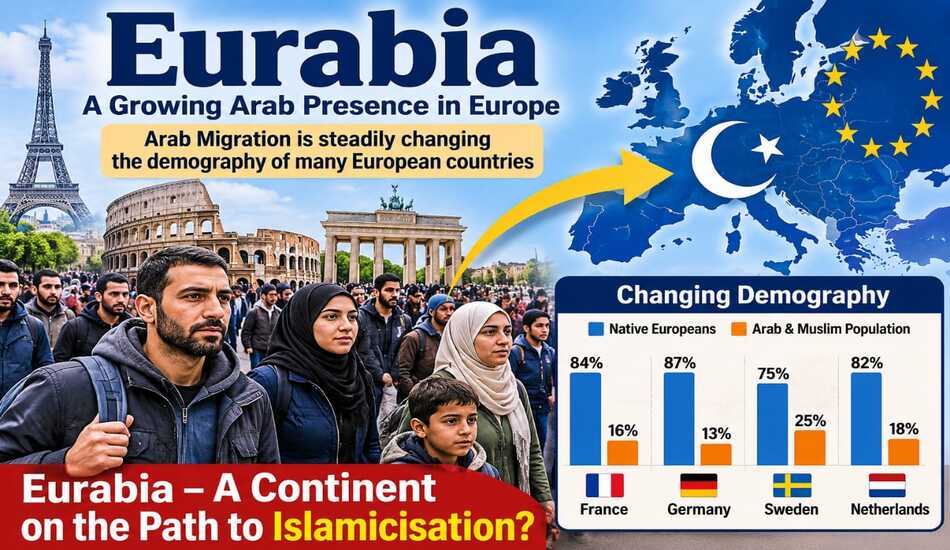


Europe has been witnessing considerable changes in its demographic and cultural composition over the last few decades. Immigration, refugee movements and the growing Muslim population have become subjects of political debate across several European countries. Against this background, a controversial political theory called Eurabia has gained attention. But what exactly does it mean? Is it a genuine concern about changing demographics, or a conspiracy theory built around fear of cultural change?
Let us examine its origin, arguments and what the available data actually tells us.
What does Eurabia mean?
The word Eurabia is a combination of two words, Europe and Arabia. It describes a theory that European countries are gradually being Islamised and Arabised through immigration, population growth and political decisions.
According to this theory, powerful political and economic groups in Europe and the Arab world have been deliberately working towards transforming Europe’s cultural and religious identity. Some versions even suggest that this is part of a long term plan involving global organisations and influential political leaders.
However, it is important to understand that Eurabia is not simply a discussion about immigration or the growing Muslim population. Its central argument is that these developments are part of a coordinated and deliberate plan.
How did the theory originate?
The theory was developed and popularised by Bat Ye’or, the pen name of Gisèle Littman, a writer who published her book Eurabia: The Euro Arab Axis in 2005.
She based much of her argument on an actual historical development.
Following the 1973 oil crisis, European countries faced serious energy shortages and economic difficulties. The European Economic Community subsequently established a dialogue with the Arab League, known as the Euro Arab Dialogue.
This initiative was intended to improve diplomatic relations, strengthen economic cooperation and ensure energy security.
Bat Ye’or interpreted this relationship differently. She argued that European countries had entered into an understanding with Arab states under which oil supplies and economic cooperation would be exchanged for political concessions, including accepting Arab immigration and allowing greater Islamic influence in Europe.
However, there is no credible documentary evidence establishing that such an oil for immigration agreement existed.
Over time, writers such as Oriana Fallaci and politicians such as Geert Wilders helped bring similar arguments into wider public discussion.
Why do scholars reject the Eurabia theory?
Many historians and political scholars consider Eurabia an anti Muslim conspiracy theory because it presents complicated international developments as the result of a secret and coordinated political design.
There are several weaknesses in this argument.
First, the Muslim population of Europe does not consist entirely of Arabs. People have migrated from Turkey, Pakistan, Bangladesh, North Africa, the Balkans and several other regions. They belong to different nationalities, cultures and religious traditions.
Second, Muslims cannot be treated as one organised political group. Their religious practices, political opinions, cultural values and levels of religious commitment vary considerably. Many are secular and have integrated into European society.
Third, there is no established evidence of a common political objective among these communities to replace Europe’s existing institutions or religious identity.
The controversy received renewed international attention after the 2011 Norway terrorist attacks. The attacker, Anders Breivik, referred to Eurabia and similar ideas in his writings. This further strengthened academic criticism of the theory and its association with extremist thinking.
Some scholars have also compared its structure to older conspiracy theories, including the notorious Protocols of the Elders of Zion, which falsely portrayed Jews as secretly controlling world affairs.
What do population figures actually reveal?
Although the conspiracy theory lacks convincing evidence, the demographic changes taking place in Europe are real and deserve examination.
According to Pew Research Centre estimates, Europe had approximately 25.8 million Muslims in 2016, representing around 5 per cent of its population. These estimates covered European Union countries, Norway and Switzerland.
Pew also examined possible population changes up to 2050 under three different migration scenarios.
The projections suggested:
-
Zero migration: The Muslim population could reach approximately 7.4 per cent of Europe’s total population.
Medium migration: The share could increase to approximately 11.2 per cent.
High migration: If very high refugee movements continued, the share could reach approximately 14 per cent.
These projections indicate that the Muslim population could grow considerably. The reasons include migration, a relatively younger population and higher average fertility rates.
However, even under the highest projection, Muslims would remain a minority of Europe’s population.
The situation also differs from country to country. Under the high migration scenario, Germany’s Muslim population was projected to approach one fifth of its total population.
These figures are projections, not guaranteed outcomes. Actual population patterns depend on migration policies, economic conditions, fertility rates and social changes.
What do these figures not prove?
This is where the distinction between demographic reality and political conspiracy becomes important.
Population growth does not establish a secret plan.
Migration takes place for many reasons, including employment, education, family reunification, political instability and wars. Refugee movements are often the result of circumstances beyond the control of either migrants or European governments.
Muslims are not necessarily Arabs.
The Muslim population of Europe is culturally and ethnically diverse. It cannot be treated as a single community with identical interests or political ambitions.
Religious identity does not automatically determine political behaviour.
Being Muslim does not mean that every individual wants to establish religious rule or change the political system of the country in which they live.
Demographic projections are not permanent predictions.
Fertility patterns often change across generations. Migrant families may gradually move towards the fertility patterns of the wider population. Migration policies can also change substantially.
Therefore, population statistics alone cannot establish the existence of an organised effort to transform Europe.
The real debate Europe must address
Rejecting the Eurabia conspiracy theory does not mean ignoring genuine challenges associated with immigration and cultural change.
European countries have legitimate reasons to debate how many immigrants they can accommodate, how refugees should be integrated, how parallel communities can be avoided and how national laws, democratic values and cultural traditions should be protected.
There are also important questions about employment, housing, education, religious freedom and the responsibilities of newcomers towards their adopted countries.
These issues deserve open discussion supported by reliable statistics rather than political slogans or religious prejudice.
Facts must be separated from fear
Eurabia is an interesting example of how genuine historical events and demographic changes can be woven into a much larger political narrative.
The Euro Arab Dialogue was real. Immigration is real. The growing Muslim population in parts of Europe is also real.
But the claim that all these developments are the result of a secret, coordinated plan to Islamise Europe has not been supported by credible evidence.
There is a difference between questioning immigration policies and blaming an entire religious community for an alleged political conspiracy.
A mature society must be able to discuss cultural change, national identity and integration without creating unnecessary fear or hostility.
The challenge is not to deny demographic change, but to understand it through facts rather than conspiracy theories.

