



Delhi’s polluted winters have become an annual struggle. Schools shut down, outdoor activities stop, and children are forced to spend days indoors as the air around them becomes increasingly difficult to breathe. But for families who cannot afford expensive air purifiers, even staying indoors does not necessarily offer protection.
For Aarkin Soni, this was more than an environmental concern. It was a problem that needed a practical solution.
A 17-year-old student from the American Embassy School in Delhi at the time, Aarkin grew up in the Delhi-NCR region after moving to Gurgaon from the United States as a toddler. Having witnessed the worsening pollution around him, he began thinking about the unequal access to something as basic as clean air.
The turning point came during a particularly severe pollution spell when Delhi’s AQI reportedly touched 1,000. Even students from relatively privileged schools were affected, with classes being disrupted. But what about children studying in under-resourced government schools, where families and institutions often cannot afford expensive air purification systems?
A conversation with a young student from a government school, who spoke about missing school and even recess because of pollution-related closures, stayed with him.
A Simple Idea with a Bigger Purpose
Along with his friend Kenichi Sasaki, Aarkin began experimenting after school. There were prototypes to build, materials to test, and plenty of trial and error. Between schoolwork and examinations, the two spent months working on an affordable alternative.
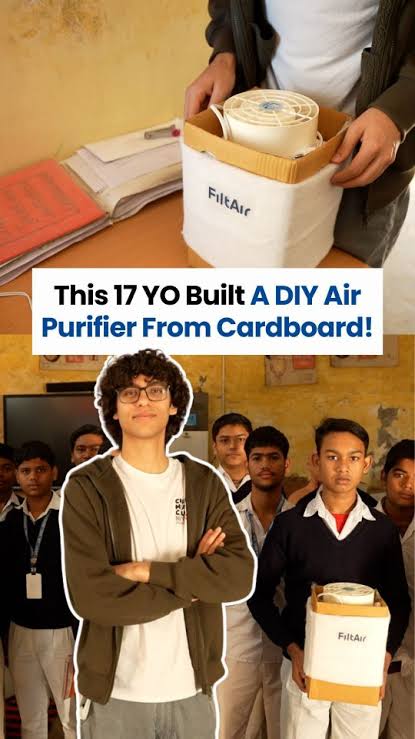
The result was FiltAir, a DIY air purifier that costs approximately ₹2,500 to assemble, compared with commercial purifiers that can cost upwards of ₹15,000.
Its design is surprisingly simple. A cardboard outer body houses a pre-filter, a HEPA filter and an exhaust fan. Polluted air is drawn through the filters, which trap particles before the air is circulated back into the room. The components are relatively inexpensive and can be replaced when required. But Aarkin’s ambition was never limited to building and selling purifiers.
Taking Clean Air into Classrooms
Through FiltAir, he began conducting hands-on workshops in government schools, teaching children about air pollution, how filtration works and how they can assemble their own air purifiers. He had reached more than 400 students across 10 government schools.
The idea was to give children more than a device. It was to give them an understanding of the problem and the confidence to experiment with solutions themselves.
Aarkin has said that many students initially believed air pollution was such a huge problem that nothing could be done about it. Learning to build their own filters changed that perception.
The team also includes Kenichi Sasaki, who leads prototyping and innovation, and Yuriko Tano, who works on marketing and branding. Their efforts earned FiltAir third place at the Diamond Challenge India Regional Live Pitch Event, organised under the University of Delaware’s global student entrepreneurship initiative.
The Work Continues
Aarkin’s work has since moved beyond the original purifier. FiltAir continues to focus on affordable air-quality solutions for public schools, combining school assessments, workshops, filtration systems and follow-up support.
In February 2026, the team also announced a hands-on air purifier innovation workshop at Delhi University’s Hansraj College as part of Delhi Climate Innovation Week.
Aarkin has also been advocating broader civic action through his initiative, Shades of Clean, which calls for cleaner public spaces, better dust control at construction sites, more green spaces and stronger community participation.
His approach is worth noticing. He is not presenting himself as someone who can solve Delhi’s pollution crisis single-handedly. Instead, he is showing young people that innovation, awareness and community participation can make a difference.
Clean air should never be a privilege reserved for those who can afford it. And perhaps the most meaningful thing Aarkin Soni has built is not just an air purifier, but the belief that even young people can take responsibility for the world they live in.

