

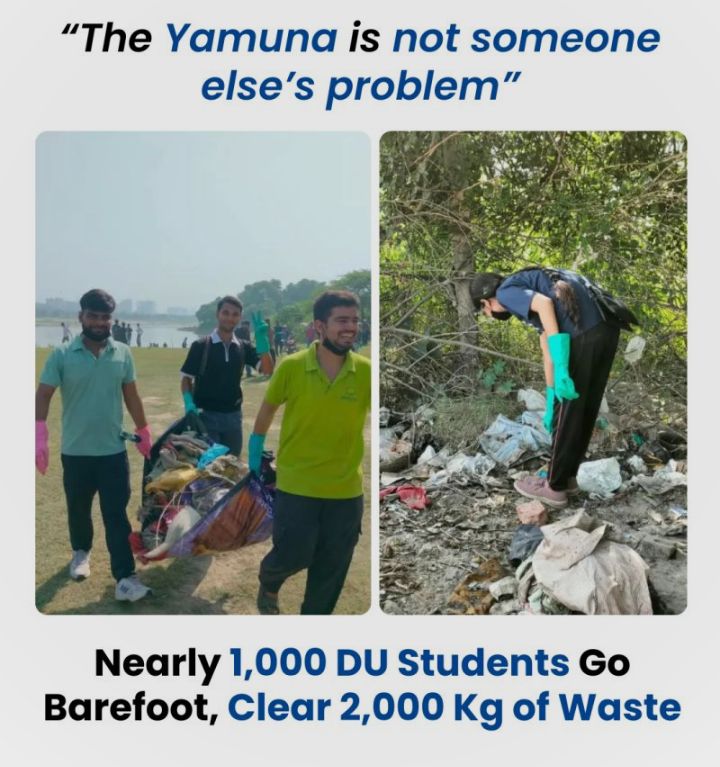


On Gandhi Jayanti, October 2, 2026, nearly 1,000 students from 15 Delhi University colleges gathered at Kalindi Kunj Ghat in New Delhi. Their mission was simple but significant: to clean the banks of the Yamuna and remind people that protecting our rivers is everyone’s responsibility.
Organised by the Green Pencil Foundation, led by founder Sandy Khanda, in collaboration with The Better India, the initiative was called Gen Z Yamuna Jal Chaupal 2026. Students from college Eco Clubs, National Service Scheme (NSS) units and youth organisations came together for this environmental campaign.
Why the Yamuna?
The Yamuna is more than a river flowing through Delhi. It is a lifeline for millions, supporting communities, agriculture, biodiversity and ecosystems along its course. Yet, years of waste disposal, pollution and neglect have severely affected its health.
Green Pencil Foundation chose the Yamuna because its deteriorating condition demands more than conversations and awareness campaigns. The foundation had already organised several clean-up drives at Kalindi Kunj, including initiatives with school and college students. Its larger objective was to make young people connect with environmental problems and take ownership of solving them.
The organisers wanted students to see the river’s condition for themselves rather than merely read about pollution in textbooks or on social media.
A Barefoot Walk Before the Cleanup
The morning began with a symbolic barefoot Padyatra towards the Yamuna.
Sandy Khanda, founder of Green Pencil Foundation, walked alongside Pankaj Kumar of Earth Warrior and Hiba Khan of Hiba Green Foundation.
The idea was to create a personal connection with the river. Walking barefoot was a reminder that the Yamuna was not somebody else’s problem. Its protection was a shared responsibility.
The message was simple: reconnect with nature before you set out to protect it.
2,000 Kg of Waste Removed in Two Hours
Following the walk, students divided themselves into three teams to make the cleanup systematic.
One team collected dry waste, another handled wet waste, while the third transported segregated material to a designated collection point for the Municipal Corporation of Delhi.
In just two hours, the volunteers removed more than 2,000 kg of waste from the riverbank. This included approximately 600 kg of discarded religious idols and 1,150 kg of solid garbage, along with plastic and textile waste. The segregated waste was handed over for municipal collection and disposal.
Beyond One Day of Cleaning
The Gen Z Yamuna Jal Chaupal was designed to be more than a cleanup campaign. It also encouraged students to discuss waste segregation, civic responsibility and the future of river conservation.
Students from different colleges shared how seeing the pollution firsthand changed their understanding of the problem. The organisers also encouraged them to take these conversations back to their campuses and communities.
The foundation’s larger vision is to build a Gen Z-led Yamuna Action Plan and continue involving student communities in environmental action.
A single morning cannot restore a river that has suffered years of pollution. But it can change the way a thousand young people look at their surroundings.
We often expect governments and authorities to clean our rivers, streets and public spaces. Their responsibility is undeniable. But ours cannot end with complaining or passing by.
The next time we visit a river, lake or public space, let us leave it cleaner than we found it. Let us reduce waste, dispose of it responsibly and encourage others to do the same. We must do this too. Rivers are lifelines. Protecting them is not an option; it is our responsibility.

