

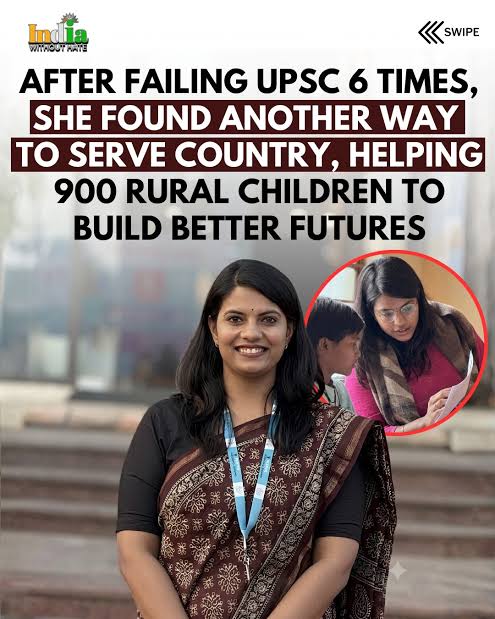


For seven years, Shruti Shrivastava worked towards a dream that had shaped almost every aspect of her life. She wanted to become an IAS officer and serve society. Six attempts, four successful prelims and one interview later, she was still not on the final UPSC list. On April 16, 2024, at the age of 30, she had to confront the end of a dream she had spent nearly a decade building.
But her desire to make a difference had never depended on a government designation.
Growing up in Madhya Pradesh, Shruti moved between towns because of her parents’ transferable government jobs. These experiences exposed her to the inequalities that existed around her. She noticed how children from economically disadvantaged families often missed out on quality education and how women were held back by social stereotypes. These observations planted an early desire to work towards social change.
A philosophy graduate from Delhi University’s prestigious Lady Shri Ram College for Women, Shruti began preparing for the Civil Services Examination in 2016. Her college years had also given her opportunities to work with children from low-income communities through a student initiative called Chehel. The experience strengthened her interest in grassroots social work.
However, the UPSC years were emotionally demanding. Each attempt brought hope, preparation and the possibility of a breakthrough. When the final result came in 2024, the disappointment was devastating. She had even recorded herself checking the results, expecting to capture a moment of celebration. Instead, the camera recorded her heartbreak.
She struggled to accept the outcome and spent weeks trying to understand what life would look like without the goal that had defined her for years. Therapy, family support and introspection gradually helped her separate her self-worth from an examination result. Her parents reminded her that a person’s contribution to society mattered far more than a designation.
And then came an unexpected opportunity.
Her college friend, Mrinalika Rathore, had founded the Sashaktikaran Foundation in 2017. After clearing the civil services examination and joining the IAS in the Odisha cadre, Mrinalika needed someone to take the organisation forward. In July 2024, she approached Shruti.
Shruti took over its leadership in Bhopal, and a new chapter began.
Through the foundation, Shruti and her team developed Project Neev, an initiative aimed at addressing the foundational learning gaps among rural children. Their approach was simple: instead of creating a parallel education system, strengthen the existing government schools.
In many rural schools, one or two teachers are responsible for several grades, leaving little time to address every child’s individual learning needs.
Project Neev uses tablets equipped with the Chimple educational application to provide personalised learning in Hindi, English and mathematics. Children participate in 30-minute daily sessions, learning at their own pace through interactive exercises. Their progress is digitally monitored.
But the initiative has another equally important dimension. Rather than bringing educators from outside, the foundation recruits and trains local rural women as Shiksha Saathis. These women facilitate the learning sessions, guide children and monitor their progress.
Today, Project Neev has reportedly reached around 900 children across 10 government schools and nine residential hostels in six districts of Madhya Pradesh. It has also created livelihood opportunities for approximately 30 rural women.
For these women, the opportunity goes beyond earning an income. It brings confidence, financial independence and recognition within their own communities. Shruti believes they are not merely beneficiaries of the initiative but changemakers responsible for transforming education in their villages.
Her work reflects a larger belief: lasting development happens when communities are equipped to lead their own change.
Shruti once imagined serving society through the administrative system. Today, she is doing it by helping children access education and enabling women to become agents of change.
She may not have secured the IAS position she worked towards, but she has found another way to serve the very people who inspired that dream. Sometimes, the destination changes, but the purpose remains.

