



When the Dream Fails Quietly: The Hidden Struggle of Young People Who Could Not Cope
Every headline about a student suicide in a premier institute is followed by public concern, debate, and eventually silence. But for every such tragic case, there are many more young people living a slower, quieter version of the same story. They did not take the extreme step. They simply stopped being able to keep up, did not get the job their family had hoped for, and slowly withdrew from the very people who once celebrated their promise. Their pain rarely makes it into any newspaper, yet almost every extended family in India knows at least one such story.
Where the story usually begins
This kind of struggle rarely starts with one dramatic failure. It begins years earlier, when a child shows early promise in studies, and the family quietly begins to see that child as the one who will lift the household’s standing. Parents who themselves struggled financially or socially often view this as the fairest way to close the gap between generations. The intention comes from love, not cruelty. The child is rarely told in so many words that they are carrying the family’s hope, yet they absorb it from the tone of everyday conversation, from how proudly their marks are announced to relatives, and from the quiet disappointment on their parents’ faces after a weak result.
This works well as long as the child keeps succeeding. The trouble begins the moment performance falls below what was expected, whether that is a disappointing exam rank, failure to clear an entrance test, or years spent preparing for a government job that simply never comes.
Why the job often does not come
There are usually several reasons that overlap, rather than one single cause. Sometimes years of entrance exam preparation leave a young person with strong subject knowledge but weak communication skills and little comfort with new environments, since normal growing up was set aside for study alone. Sometimes the degree comes from an institution or a stream with weak placement support, and no one in the family has the knowledge or contacts to guide the young person toward better options. Sometimes a student is pushed into a subject purely because it is seen as respectable, without regard for whether they were suited to it. And often it is simply the scale of competition today, where thousands of hardworking young people chase a small number of secure jobs, so even a genuinely capable person can spend years without success through no real fault of their own.
Families rarely separate the cause from the child. The explanation offered at home, and to relatives, tends to be some version of he did not try hard enough, because this is easier to accept than admitting that the entire plan the family had built its hopes around carried weaknesses no one could have foreseen.
What happens inside the person
The psychological toll of this is heavier than most families realise. The young adult usually goes through years of continued effort, applying, preparing, trying again, while quietly watching school and college friends move ahead into jobs, marriage, and independent life. Each passing year without a result adds to a growing belief that they are the exception, the one who simply could not make it. Confidence erodes slowly rather than all at once. By their late twenties, many such young people have stopped believing they can succeed at anything at all, not only the original goal, because failure has quietly become the story they tell themselves about who they are.
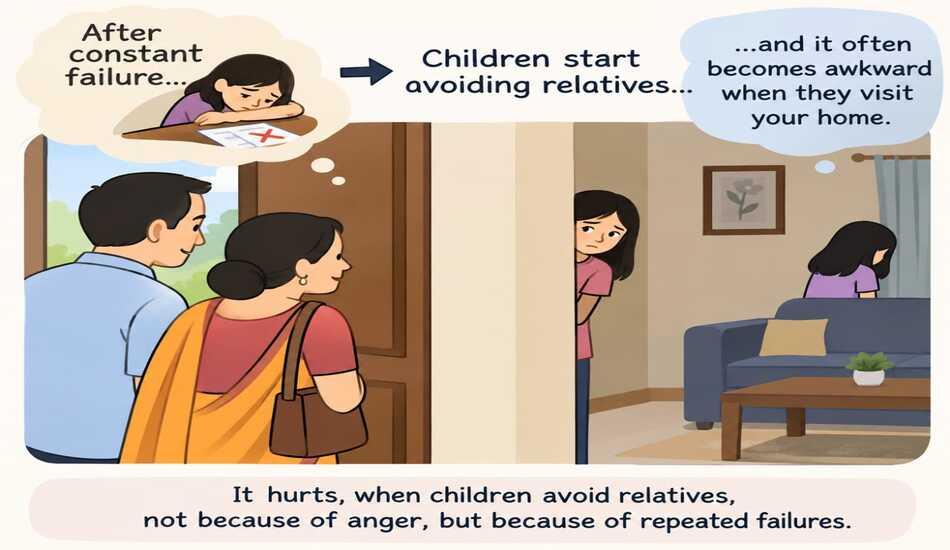
At the same time, they usually sense their parents’ disappointment clearly, even when nothing is said aloud. This creates a particular kind of guilt, different from ordinary sadness, the guilt of being a source of worry rather than pride to people they love. Avoiding relatives is very often not anger or laziness. It is an attempt to protect themselves from the same painful questions repeated at every gathering.
Why relatives make it worse without meaning to
Indian extended families are close knit, and asking about a young person’s career or marriage is treated as ordinary, even affectionate, conversation. Few relatives realise how a simple question such as what is he doing these days lands on someone who has spent years failing to answer that question to their own satisfaction. Comparisons with cousins who did succeed, even meant lightly, confirm the exact fear the young person already carries. Over time, many such young adults find it easier to stop attending family gatherings altogether, which the family then reads as rudeness or depression, rather than as the self protection it usually is.
What tends to help
Families that manage to turn this around usually do a few specific things. Parents actively tell relatives, in advance, that questions about jobs or marriage are not welcome, rather than leaving their child to face them alone. This one step removes a large part of the daily dread. Families also begin treating a different kind of work, a smaller job, a trade, a delayed career, or even a period of rest to rebuild confidence, as a legitimate outcome rather than a failure to be hidden. This shift in language at home changes how the young person sees themselves far more than any pep talk can.
Professional counselling, though still under used in most Indian households, has genuine value here, not because the person suffers from any serious illness, but because a trained outsider can help them separate their sense of worth from one unmet target, something parents, however loving, usually cannot do, since they are part of the very hope that was placed on the child in the first place.
Finally, exposure to a wider range of respected paths helps enormously. Young people who eventually build a stable life outside the narrow list of engineering, medicine, or government service, in trades, small business, creative work, or other services, tend to recover their confidence once they see that a respectable life does not require the one goal they originally aimed for.
A story worth telling
The dramatic cases make the news. The quiet cases, someone drifting for years, avoiding family, slowly losing belief in themselves, never make it into any newspaper column or parliamentary report. Yet for every headline there are almost certainly many more families quietly living through exactly this. Writing about this side of the problem, without sensationalising it and without blaming either the child or the parents, may serve readers far more than writing about the extreme cases alone, since so many more families are silently carrying this weight.
If this reaches anyone who feels their own worth has been reduced to one unmet goal, it may help to gently remind them that talking to a counsellor or a trusted professional is a sign of strength, not defeat.

