

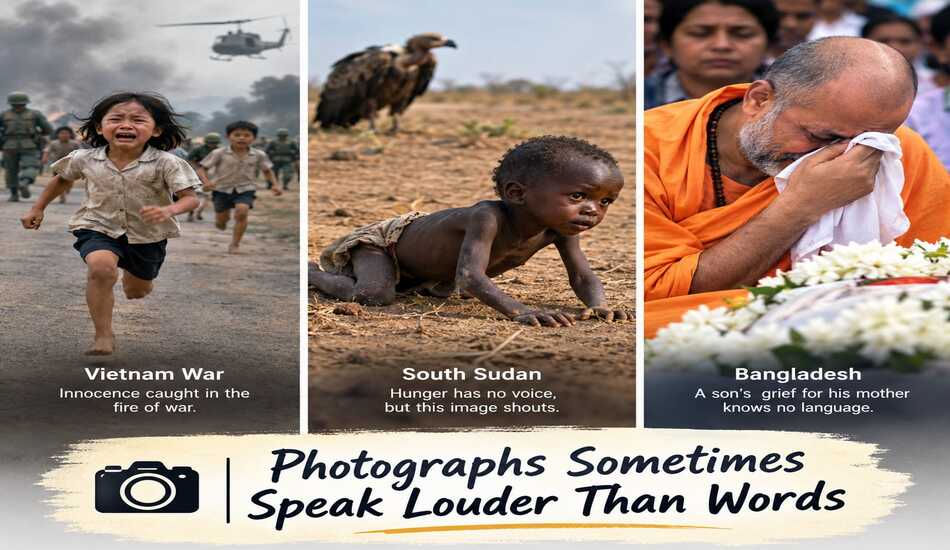


A religious book may explain the philosophy of death and rebirth. A photograph of a grieving believer shows how that philosophy lives inside a real human being at the most difficult moment of life.
This is why some photographs become historical documents. They cross language barriers, national boundaries and generations. Powerful photographs therefore deserve both emotion and verification. Still, when an authentic photograph captures a truly significant human moment, words often become secondary. The camera records a fraction of a second, and human beings give that fraction a meaning.
That’s why these three photographs can speak louder than a million words.
We live in a world full of words. Speeches, news reports, statements and long debates reach us every day, and most are forgotten by evening. Yet one photograph can stay in the mind for fifty years. It needs no language and no translator. A mother in Kerala and a farmer in Poland read the same pain on the same face. Here are three photographs that show how a single image can say what a thousand pages cannot.
The Girl Who Ran From the Fire
On June 8, 1972, Nick Ut, a photographer with the Associated Press, was standing near the village of Trang Bang in South Vietnam. A napalm strike had hit the wrong place, and villagers were fleeing down the road. Out of the black smoke came screaming children. In the middle was a nine-year-old girl named Phan Thi Kim Phuc. Her clothes had burned away, her arms were held out from her body, and her mouth was open in pain and terror.
Ut took the picture, then put down his camera, gave her water and rushed her to a hospital. The photograph won the Pulitzer Prize in 1973. Many people believe it turned American public opinion against the war more than any speech or report had done. Kim Phuc survived after many operations. Today she lives in Canada and speaks for peace.
The Child and the Waiting Bird
In March 1993, photographer Kevin Carter travelled to southern Sudan during a terrible famine. Near a feeding centre he photographed a tiny, starving child who had collapsed on the ground, with a vulture standing close behind. When The New York Times printed the picture, readers flooded the newspaper with letters asking what had happened to the child. Carter received the Pulitzer Prize in 1994. The image also began a hard debate about what a photographer owes to the person in front of the lens.
Sadly, the story did not end in 1993. Since war broke out in Sudan in 2023, aid agencies have warned of severe hunger, and in some areas famine, with millions of people short of food. The old photograph now reads like a warning the world was slow to learn.
A Son at His Mother’s Last Rites
The third photograph is very recent, and it is the picture of a son. Chinmoy Krishna Das, born Chandan Kumar Dhar, is a Hindu monk from Chattogram in Bangladesh and a former ISKCON member. He became the spokesperson of a group that demands protection for Hindu minorities. He was arrested at Dhaka airport on November 25, 2024, on sedition allegations, after a saffron flag was said to have been placed above the national flag at a rally in Chattogram. He now faces six criminal cases and has won High Court bail in four of them. He remains in prison because his bail in the sedition case is stayed, and a murder trial is under way before the Chattogram Speedy Trial Tribunal. That case concerns the death of government prosecutor Saiful Islam Alif during the protests that followed his arrest. Five Hours Out Of Jail, A Son’s Final Goodbye: Chinmoy Das Attends Mother’s Funeral In Bangladesh.
His mother, Sandhya Rani Dhar, was 71. She had long suffered from cancer, along with heart disease and other age-related complications, and her family said she was under severe mental stress after her son’s arrest. On Wednesday, September 9, the family asked the Chattogram district administration for conditional parole so that he could see her. Reports say the request was refused because officials said there was no provision to grant parole to a prisoner to visit a sick relative. Chinmoy gets five-hour parole to attend mother’s last rites.
She died on Thursday, September 10, 2026, at the Pundarik Dham ashram in Hathazari, without seeing her son. After her death the parole was approved for five hours, and he was released from Chattogram Central Jail at about 4 pm. A video then went viral of him breaking down in tears at the feet of a Radha Krishna idol, at the place where his mother was cremated. After the rites he was taken back to jail. (Bangladesh: Hindu priest Chinmoy Krishna Das’s mother dies without seeing jailed son.)
What These Pictures Teach Us
These three pictures come from different lands and different years, yet they do the same work. They make distant suffering personal. A number about war or hunger is easy to scroll past. A burned child, a starving child or a weeping son is not. Each of them asks us to stop and look.
At the same time, a good reader should ask who took the photograph, when it was taken, and what happened before and after the moment. Pictures touch the heart, and facts steady the mind. We need both. When a photograph moves you, let it begin your thinking, not end it.

