



Time Capsules: Messages We Leave for Tomorrow
Every generation wants to speak to the future. Long before letters could travel through time, people found a simple way to do it. They buried objects, documents and memories in the ground, trusting that someone, someday, would dig them up and understand who came before them. This is the idea behind a time capsule. Today, let us look at a few such capsules, some from India, and one from far away in the Arctic.
The Ram Mandir Capsule: Planned, But Not Confirmed
In July 2020, just before the foundation laying ceremony of the Ram Mandir in Ayodhya, a member of the Shri Ram Janmabhoomi Teerth Kshetra Trust, Kameshwar Chaupal, told the media that a time capsule would be placed about two thousand feet underground at the temple site. The plan, as described then, was to inscribe a message in Sanskrit on a copper plate, called a Tamra Patra, and bury it deep below the temple. The purpose was clear. It would carry an account of Lord Ram, Ayodhya and the long legal struggle over the site, so future generations would have a clear historical record and no fresh dispute could ever arise.
Copper was chosen because it does not corrode easily and can preserve writing for a very long time. It was also mentioned that in 1989, when the temple’s foundation stone was first laid, a copper inscription was buried at the same spot under the guidance of Ashok Singhal of the Vishwa Hindu Parishad.
However, within just two days of this announcement, the trust’s general secretary, Champat Rai, publicly denied the entire report. He stated clearly that all reports of a time capsule being placed at the site were false and asked people not to believe such rumours. Since then, there has been no official confirmation from the trust that such a capsule was ever buried. So while the idea was seriously discussed and reported widely, it remains an unconfirmed plan, not a verified fact. This is worth remembering whenever this story comes up in conversation, because two versions exist, and only one side has spoken with certainty.
The IIT Kanpur Time Capsule: A Confirmed Story
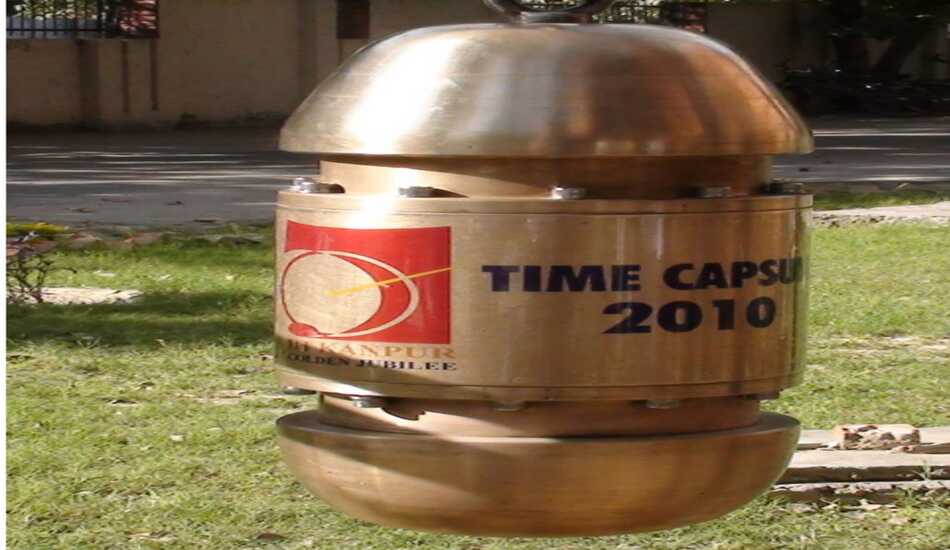
Unlike the Ayodhya case, the time capsule at IIT Kanpur is well documented and confirmed. On 6 March 2010, during the institute’s golden jubilee celebrations, the then President of India, Pratibha Patil, personally buried a time capsule on the campus. It was built from a special metal and shaped like a three foot long cylinder, made of an inner section and an outer shell in three cast parts. The whole capsule weighed close to two hundred and eighty five kilograms.
Inside, the institute placed items that took six months of thought and planning. There were photographs collected over fifty years, an aerial map of the campus, a replica of the President’s Gold Medal, copies of the institute’s founding statutes and rules, even a weekly hostel mess menu and records of birds seen on campus. Minutes from the first and the hundredth Senate meetings were included too, along with annual reports and a film about the institute made in 2009. This capsule stands as a genuine and carefully documented example of preserving history for the future.
It is worth noting that Aligarh Muslim University also has a strong tradition in this area. A time capsule was buried there in 1877, when the institution began as Muhammadan Anglo Oriental College, and another one was placed in 2020 to mark its centenary.
The World’s Largest Seed Time Capsule
While Indian institutions have buried documents and objects, one place in the world protects something even more essential to human survival, our food. The Svalbard Global Seed Vault, built deep inside a mountain on a remote Norwegian island under permafrost, stores duplicate seed samples from gene banks across the world. By the middle of 2026, its collection had crossed one point four million seed samples, contributed by more than one hundred and thirty countries and institutions. The seeds remain the property of the depositing country, and the vault does not distribute them. It simply protects them, so that if any nation’s own seed bank is ever destroyed by war, disaster or neglect, the original variety can still be recovered.
In a way, this vault is also a time capsule, not of words carved on copper, but of life itself, waiting quietly under Arctic ice for a future that may one day need it.
Time capsules, whether confirmed or still debated, remind us of a simple human wish, to be remembered, and to help those who come after us understand where they stood on the shoulders of history.


It’s a great piece of information. I wasn’t aware about something like this.
it’s a great idea though ….
Just as there exists the fear of the unknown, there is also the excitement of the future. Such time capsules help in maintaining a positive attitude towards the future… A time many of us may not see, but will be communicating through these interesting bits of innovative ideas. Very informative piece
Sir in my opinion relevance of times capsule is exaggerated form of self promotion, nothing for next generation learning. Honest documentation of the present would definitely be a treasure for the future. Our history writers were biased so still facing all sorts of problems by the humanity. Good and very interesting blog sir g. I’m getting addictive to. 🙏
Comment by Arvind Chaudhary
Dear Guar ji ,
I read your article ..
on time capsules as messages to future generations, using the proposed Ayodhya capsule, the documented IIT Kanpur capsule, and the Svalbard Global Seed Vault as examples. The central idea is that we are not merely preserving objects—we are preserving memory, knowledge, values and hope for those who come after us.
A time capsule is much more than a box buried underground—it is a conversation between generations.
What we choose to preserve tells the future what mattered to us: our achievements, our struggles, our knowledge, our culture and even our hopes. The IIT Kanpur example beautifully demonstrates how everyday records can become valuable historical evidence with the passage of time. And the Svalbard Seed Vault takes the idea to even deeper level..
Perhaps the most important time capsule, however, is the one we create through our actions today. The values we teach our children..
Comment by T. V. Raveendran
Dear Jay, your concept of time capsule is unique I was not aware such capsules of present is preserved for future generation to examine and ascertain facts about past .In ancient time this can be witnessed from sculptures on temples , caves etc just to make us understand the past.Your Ram Mandir statement of time capsule really makes me feel critical about the unending controversy over the past and prevailing issue our so called Hindu fanatics which I will stress on this word is once again a disturbing factor .This by and large is drenched in political shadow rather then makeing it upright on real cause .Last but not the least the seed bank concept is superb it’s for the real cause and betterment of human race.The studies will be of great use for biogenetic and related research for our benefits.Great subject rather subject of future .I finally appreciate your versatile knowledge and taste to pursue new morden subject.
Comment by R. B. Bhosale