

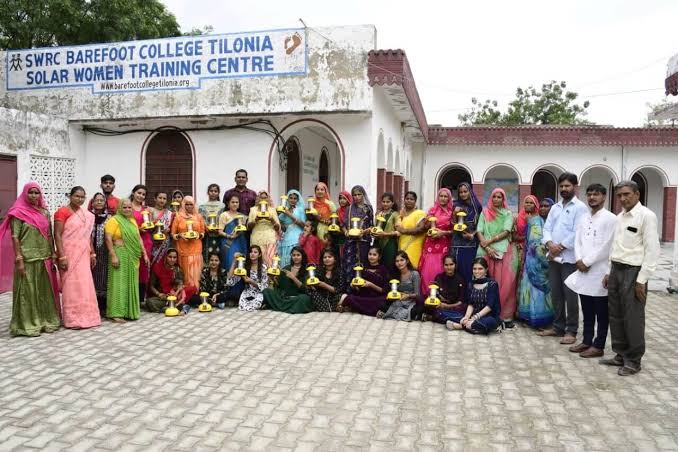


In villages where darkness once brought daily life to a standstill, a new kind of engineer is changing the future. She may be a grandmother who has never attended school, never handled an electronic circuit and never travelled beyond her village. Yet, after training at Barefoot College in Tilonia, Rajasthan, she can install and repair solar lighting systems that illuminate homes across her community.
These women are known as Solar Mamas. Their story challenges a deeply rooted belief: that advanced technology belongs only to people with formal education.
A Different Kind of College
The story began in 1972, when Indian social activist Sanjit “Bunker” Roy founded Barefoot College. Inspired by Mahatma Gandhi’s philosophy of self-reliance, Roy believed rural communities possessed valuable knowledge and abilities that conventional education often overlooked.
His vision was to help villagers solve their own problems instead of depending entirely on outside experts. The organisation worked across areas such as education, healthcare, water and livelihoods, with technology placed in the hands of the communities that needed it most.
The solar programme emerged from this philosophy. Rural households without reliable electricity often depended on kerosene lamps, which were costly, produced harmful smoke and provided inadequate light for studying or working after sunset.
Bringing conventional electricity infrastructure to remote settlements could be difficult and expensive. Barefoot College offered another solution: train local women to bring solar power home and maintain it themselves.
Launched in the late 1990s, the Solar Mamas programme trains rural women, many of them middle-aged or grandmothers, to become solar engineers. Participants are generally selected with their communities’ involvement, with preference given to women who are likely to remain in their villages and share their skills locally.
The training turns conventional education on its head. Women who cannot read technical manuals fluently learn through demonstrations, colour-coded components, shapes and repeated hands-on practice.
Women speaking different languages can learn alongside one another without relying on written instruction. Over a residential course, they learn to assemble, install, maintain and repair solar lanterns and household lighting systems. They return home equipped to put their training into practice, often serving as the technicians their communities previously lacked.
The programme’s reach is remarkable. According to the International Renewable Energy Agency, more than 1,700 women from 96 countries had been trained, helping electrify approximately 75,000 homes and 1,300 villages. The programme has also been credited with avoiding the use of around 45 million litres of kerosene.
These figures reflect more than access to electricity. Solar lighting allows children to study after sunset, gives families more time for household activities and can help women pursue income-generating work. It also reduces reliance on smoky, polluting fuels.
A study of communities in Humla, Nepal, where three Solar Mamas installed 220 solar home-lighting systems, reported that the proportion of women using skills for income generation rose from 17% to 86%. The study also recorded improvements in children’s evening study routines and women’s participation in household decisions. These findings concern the surveyed communities, rather than every village served by the programme.
The transformation extends beyond technology. A woman once excluded from technical work becomes someone her neighbours approach for expertise. Her skills can bring her income, confidence and a stronger voice in community decisions.
The model also challenges social barriers around gender, age, caste and education. Rather than asking rural women to leave their communities behind to succeed, it equips them to build opportunities where they already belong.
The movement continues in Rajasthan. In January 2026, Barefoot College, Tilonia, announced a partnership with RAJEEVIKA, Rajasthan’s rural livelihoods mission, to advance women-led green initiatives. The collaboration reflects continuing efforts to connect practical technical training with livelihoods and clean-energy opportunities.
The real achievement of Barefoot College is not simply that grandmothers have learned to work with solar panels. It is that a lack of formal education has not been allowed to define the limits of their contribution.
When these women return home, they carry more than technical skills. They carry the power to light their villages—and the proof that opportunity can begin at any age.

