

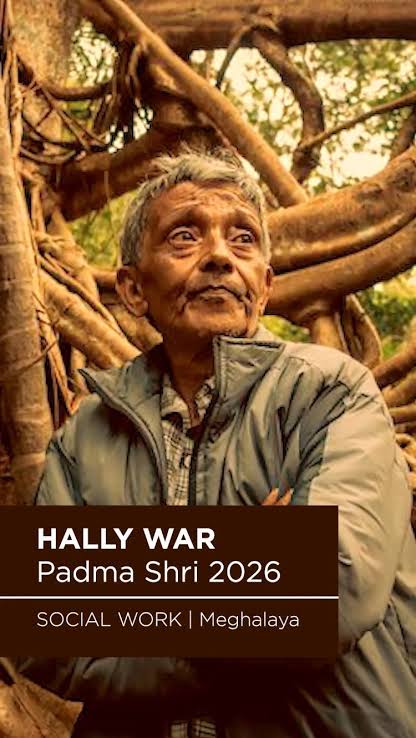


In the misty hills of Meghalaya, where rivers cut through deep valleys and rain shapes the landscape, a young boy once watched his family work with the roots of trees. He was barely 10 when Hally War began learning an ancient Khasi skill from his father and grandfather one that would eventually become his life’s purpose.
Born and raised in Siej village near Sohra (Cherrapunji), in Meghalaya’s East Khasi Hills, Hally grew up surrounded by the forests and traditions of the Khasi community.
As a child, he would see elders guide the aerial roots of the Ficus elastica, or rubber fig tree, across streams and rivers. What may have looked like child’s play slowly became an extraordinary lesson in patience, nature and indigenous engineering.
The Khasi people call these remarkable structures Jingkieng Jri living root bridges. Unlike conventional bridges, they are not built and finished. They are grown. Young roots are carefully guided across a river using bamboo and wooden supports. Over years and decades, they grow, intertwine and strengthen, eventually forming a natural bridge capable of carrying people across difficult terrain. Hally War dedicated more than five decades to mastering and preserving this knowledge.
One of his best-known creations is the Umkar Living Root Bridge, built over the Umkar River near his village. His work did more than provide a crossing for local people.
It helped preserve an ancient relationship between the Khasi community and its natural surroundings. His efforts have also contributed to sustainable tourism and inspired younger generations to learn the traditional craft.
A Farmer, A Father, A Guardian: Despite the extraordinary legacy he was creating, Hally War remained a farmer. He cultivated betel nuts, betel leaves, black pepper, bay leaves and fruit crops, living close to the land he had spent his life protecting.
He is also a father of four, and the knowledge that he inherited from his elders did not stop with him. He has passed the craft on to his sons and grandsons, while also guiding other local families in caring for living root bridges.
For years, his work received little national attention. He continued quietly, growing bridges, tending his plantation and protecting a tradition that could easily have disappeared. Then, in January 2026, the nation finally took notice.
From Village Roots to Padma Shri: Hally War was named a recipient of the Padma Shri 2026 for his contribution to social work, environmental conservation and the preservation of indigenous Khasi practices. The official citation recognised his decades-long work in bio-weaving living root bridges and strengthening the connection between community, culture and nature.
On 25 May 2026, President Droupadi Murmu formally presented him the Padma Shri at Rashtrapati Bhavan. For Hally War, the honour was not simply a personal achievement. It was recognition for the wisdom of his ancestors, and for a way of living in which nature is not conquered to build something, but patiently nurtured to become something.
In an age of concrete bridges and instant construction, Hally War’s greatest lesson may be beautifully simple: Some of the strongest things in life are not built. They are grown.

