



Industrial Revolutions and the Myth of Job Loss
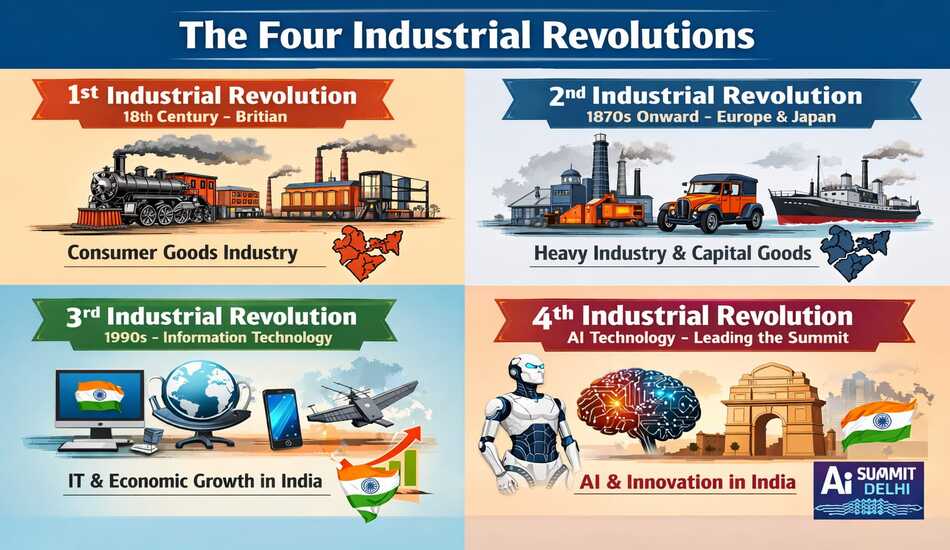
Till today, the world has witnessed four major industrial revolutions. The first two revolutions took place when India was under British rule. Their benefits largely went to the rulers, not to the people of India. However, the third and fourth revolutions happened after India’s independence, and we are experiencing their impact in our own time.
Every industrial revolution brings fear along with opportunity. People often worry that new technology will destroy jobs and harm human livelihoods. In some cases, these fears are partly true because certain types of work disappear. However, history shows that every revolution eventually creates more opportunities than it destroys. It takes something away but gives much more in return.
Let us understand the myths and realities of each industrial revolution.
First Industrial Revolution
The first Industrial Revolution began in United Kingdom in the late 18th century and gradually spread to other European countries. It was mainly based on the production of consumer goods through machines.
At that time, India was under British colonial rule. British industries produced goods in factories and dumped them in Indian markets. As a result, India’s traditional handicraft industries declined. Many Indian artisans and workers lost their livelihoods, and the country experienced large-scale de-industrialisation.
Even workers in Britain were afraid of machines. They believed machines would replace them and make them jobless. This fear led to a movement called the Luddite Movement, where workers destroyed machines in protest. But over time, the industrial economy expanded and created new kinds of employment.
Second Industrial Revolution
The second Industrial Revolution began around 1870. This phase focused mainly on capital goods and heavy industries such as steel, electricity, chemicals, and machinery. These industries produced the equipment needed for other industries to function.
During this period, railway networks expanded rapidly across Europe and also reached countries like Japan in Asia. Industrial development accelerated, but India continued to suffer because colonial policies prevented local industries from growing.
The social tensions created by industrial capitalism led to major ideological debates. The ideas of Karl Marx about labour, capitalism, and class struggle became very influential. These tensions eventually contributed to the Russian Revolution, which reshaped global politics.
Both the first and second industrial revolutions weakened the Indian economy.
Third Industrial Revolution
The third Industrial Revolution began around 1990 and was driven by information technology. This was the first major technological revolution in which India actively participated.
Several developments prepared the ground. In 1988, satellite television brought international programmes to India. In 1991, the internet was introduced and became widely operational by 1995. The telecom sector expanded rapidly, and digital communication became easier through systems like direct dialling.
A major step was the establishment of the Centre for Development of Telematics (C-DOT) in 1988. Visionary leaders like Sam Pitroda played an important role in strengthening India’s telecom and computer infrastructure and promoting computer education.
Initially, many people feared that computers would eliminate manual jobs. However, the opposite happened. The IT revolution opened huge opportunities for educated young people in software development, telecommunications, and related industries. Older generations also gradually adapted to computers as part of their work.
India had a strong advantage because many Indians were skilled in English and mathematics. Western countries had advanced technology but needed skilled manpower. This led to outsourcing in areas such as medical transcription, teleconferencing, and call centres.
This transformation was often called a silent revolution” After agriculture, the service sector became the main driver of the Indian economy. Banking, insurance, and private sector industries expanded rapidly, especially after the year 2000. Fields such as biotechnology, nanotechnology, and 3D printing also began to grow.
Fourth Industrial Revolution – Artificial Intelligence
Today, the world is experiencing the fourth Industrial Revolution, driven by Artificial Intelligence (AI). AI is transforming many sectors, but it has also created widespread fear. People worry about deepfakes, cyber threats, privacy issues, and large-scale unemployment.
However, global leaders are increasingly discussing how to use AI responsibly. Several international AI summits have already taken place. In 2025, a major summit in Paris was co-chaired by Narendra Modi and Emmanuel Macron. India later hosted another major summit in New Delhi, which saw participation from thousands of experts, companies, and leaders from many countries.
India emphasised that AI should not remain the secret technology of a few powerful nations. Instead, it should be accessible to all countries. India also aims to act as a bridge between advanced economies and the Global South.
India has strong advantages in the AI era. It has one of the largest pools of STEM graduates, strong software capabilities, and a powerful digital infrastructure such as Unified Payments Interface (UPI). Major companies including Google, Microsoft, Tata Group, and Reliance Industries are investing heavily in AI and data centres in India.
AI will certainly automate some jobs, but it will also create new opportunities in fields such as healthcare, education, agriculture, and governance.
Challenges Ahead
Despite the opportunities, India must address several challenges:
Large-scale skilling and reskilling of the workforce
Strong data protection and security systems
Effective AI governance and regulatory institutions
Development of AI models in Indian languages
Indian companies such as Sarvam AI have already started building local language AI models, but much work still remains.
Conclusion
History shows that every industrial revolution brings fear at first. Yet, in the long run, technological progress creates more opportunities than problems. The fourth industrial revolution based on AI is no different.
If India invests in skills, technology, and responsible governance, AI will not be a threat. Instead, it can become a powerful tool for economic growth and social development.
Reference

