



When the Notice Shook Everything, And What Nobody Spoke Aloud
The night before the AIPMT 2004 exam, we hardly slept.
My daughter had been preparing for months. Her textbooks were worn out, her notebooks were full of human anatomy diagrams and biology notes. Physics numericals were written in red ink. She was a Class 12 student appearing for board exams and AIPMT in the same year. She wanted to be a doctor, not because anyone pushed her, but because she had decided it herself, quietly and firmly, the way determined young women do.
Getting to Delhi was a small battle. In 2004, railway reservations were not like today. You could not book tickets with one click. People stood in long queues at Railway Station before dawn, hoping the clerk would not write “Waiting List” on the ticket. We got two confirmed tickets after three visits in two weeks. I kept them in my inner shirt pocket and checked them every hour during the journey.
We reached a day early and took a room in Ginger Hotel of the Tata group, right opposite New Delhi Railway Station. It was close to the exam center, a clean room with all facilities. For a girl traveling to a new city, safety was always on our mind. Boys of her age came in groups and moved around freely. For us, every decision was made with care. Which lodge to choose, which route to take, what time to leave, everything was planned carefully.
She revised her notes that evening under a tube light while I sat beside her, pretending to read a newspaper.
Sunday morning came with tea from a roadside stall and a sky that was still turning from pink to grey. We reached the center early. Students with admit cards and parents with worried faces had gathered at the gate.
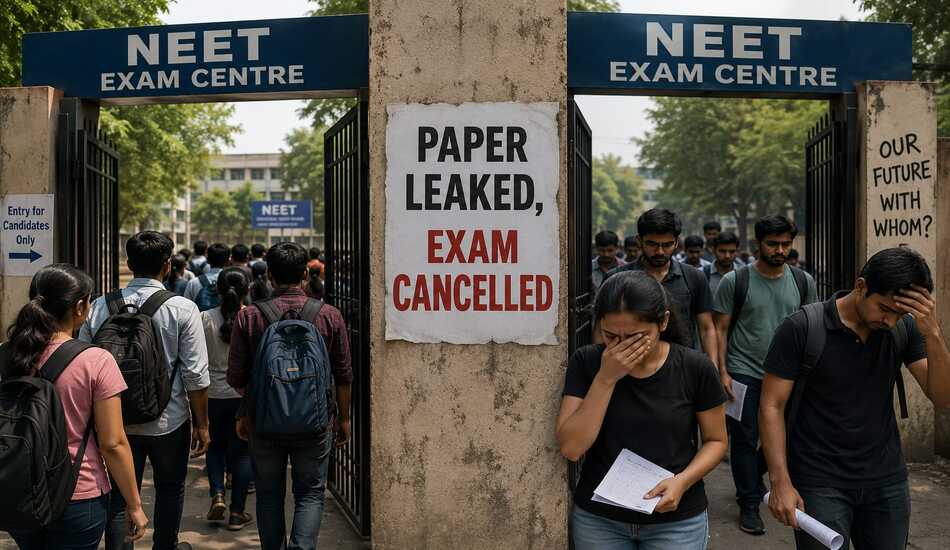
Then we saw it. A paper pinned to the gate.
CBSE had cancelled the AIPMT Preliminary Exam because the question paper had leaked. The paper was sold for lakhs of rupees by people with no conscience and no care for the futures they were destroying.
I looked at my daughter. She had already read it.
There was no loud cry. There was only a long silence, like the moment after a lamp goes out. She folded her admit card slowly and put it in her bag.
Now the real problem started. Return tickets. Our confirmed reservation was for Tuesday. Staying two more nights meant extra cost we had not planned for. I made calls from a PCO booth to my contact while my daughter waited on a bench outside with her question bank open on her lap. We managed, the way Indian families always do.
The re exam was held weeks later. My daughter appeared but made a common mistake. She did not understand negative marking properly. She scored 264 marks. The cut off was 292. She missed it by just 28 marks. Twenty eight marks that felt like twenty eight years.
I put her in a local coaching center and signed her up for Allen Kota’s test series for Prelims as well as Mains.
I don’t believe in sending kids to Kota or Delhi for coaching. Home is best. That’s where you get real moral support when the pressure and nervousness hit.
But she was stronger than disappointment. She studied harder through 2004 and 2005. This time she understood exam strategy, negative marking, and the importance of answering only sure questions. In 2005 she appeared again, and qualified for Mains, and cleared the Prelims with 325 marks.
For Mains descriptive answers, she followed every key instruction: she didn’t cross anything out, did all rough work and calculations on the left side of the page next to the question, and kept her answer booklet neat and tidy. Examiners value cleanliness a lot – a clean booklet gives you an edge in descriptive papers.
Her All India Rank was 1105. She got selected for a government medical college. I cried quietly that evening, remembering every queue I had stood in.
AIPMT 2005 – Selection Data
- Preliminary Test: 2.10 lakh candidates appeared
- Main Exam: 17,108 candidates qualified for the main exam. It was descriptive type
- Counseling: 3,308 candidates qualified for counseling
- Final Selection: 1,654 candidates were selected
- Reservation: There was no reservation for these 1,654 seats
- Number of attempts allowed to
Qualify : 3
Paper Leak Theory
Now let me tell you what the waiting parents were discussing quietly outside the exam gate that morning.
They spoke about a mafia that was organized, well connected, and spread across many states. These men would go to different cities and meet doctors who ran private clinics or hospitals. They would ask a simple corrupt question. Does your son or daughter have the marks to qualify on their own? If not, we can manage the paper. Pay some money now. Pay the rest after selection.
This was not just a rumor. Police investigations after AIPMT 2015 proved this model. The main person, Roop Singh Dangi, ran a nationwide network of agents. Their job was to find student families, take advance money, and send answer keys through Bluetooth devices and SIM cards bought with fake IDs. Pay after selection. That showed how confident they were.
The second way was quieter but just as corrupt. After four or five rounds of counseling, some seats stay empty. The rules say these seats must go back to CBSE for fair allotment. But at the level of officers and politicians, these seats were secretly given to favored students, not to deserving ones. There was no record. No court case. Just one phone call and the seat changed hands.
Why does this corruption exist
The answer is one harsh number.
A government MBBS seat costs a family about ₹1200 per year in states like Assam, or ₹6500 for the full course at all AIIMS, or ₹3500 to ₹45000 per year depending on the state. A private medical college seat costs close to one crore rupees in total. That gap, between a few thousand and one crore, is the main reason for corruption in medical admissions. When paying ₹8 to ₹10 lakh to a mafia agent saves your family ₹90 lakh, the math becomes tempting for desperate families.
The state-wise fee structure list was displayed on the notice board at the CBSE Counselling Centre in Delhi.
The mafia did not create this problem. The fee gap did. Until India reforms medical education funding and increases government seats in a real way, the paper leak business will find buyers in every city, in every exam cycle, waiting quietly outside exam centers.
The Paper Leak Mafia’s Shield: A Toothless Law
India’s paper leak mafia operates with near-total impunity because the punishment simply doesn’t fit the crime. For decades, cheating cases were prosecuted under IPC Section 420 meant for ordinary fraud, carrying a maximum of 7 years imprisonment.
For criminals who destroy lakhs of students’ futures and pocket crores in bribes, seven years is not a deterrent. It’s a calculated business risk.
The Public Examinations (Prevention of Unfair Means) Act, 2024 was finally enacted after the NEET-UG scandal, raising penalties to 10 years and fines up to ₹1 crore. But implementation remains weak, bail is routine, and conviction rates stay dismally low.
When the profit from one leaked paper runs into ₹50-100 crore, even a ₹1 crore fine is just a cost of doing business. Until sentences become non-bailable, non-compoundable, and swift, the mafia will keep leaking — and keep laughing.
The law upgraded the punishment. The system never upgraded the will to punish.
Some battles, as my daughter’s story shows, are won through honest hard work and never giving up. But for every family like ours, another family somewhere made a different choice. Not because of greed, but because the system made them feel they had no other option.


This is horrible situation for all students but in such situation you and your daughter were very calm.
She again studied very hard with focus and finally got 1105 rank.
It’s a great achievement .
Government should take proper action by maximum punishment.
My salute to you as you remember everything which happened before 20 years.
Thanks for sharing this information. 🙏🙏🙏
Struggle days stay with you forever.
Thanks for reading.. 🙏