

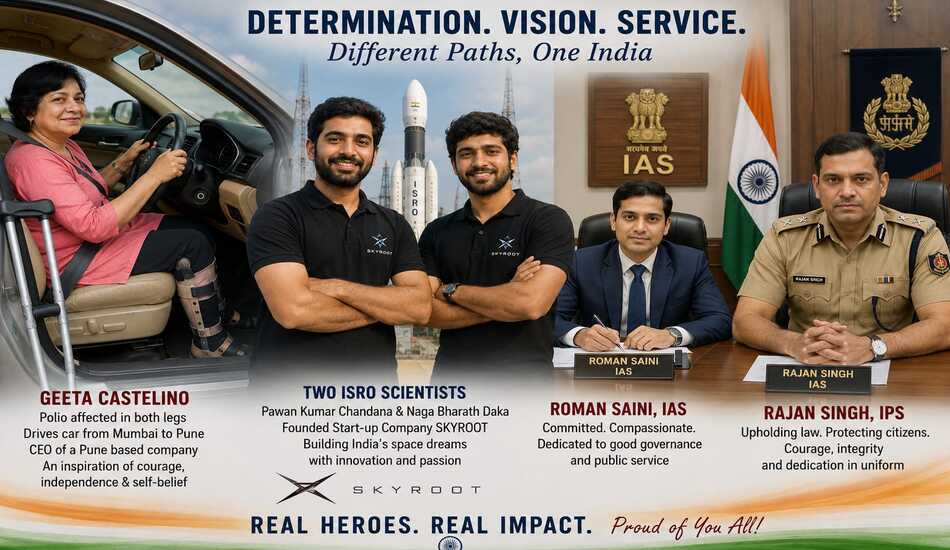


Geeta Castelino and The Question We Are Afraid to Ask
A Life That Refused Limits
A few days ago, on the Marathi podcast Kutuhalwithswati, I heard the story of Geeta Castelino. Polio took the strength of both her legs when she was two and a half years old. She never got the gift that most of us take for granted, the simple act of standing up and walking across a room. Yet she went on to become an expert in textile engineering, drove a car in competitive rallies, ran an NGO as its CEO, and chaired several government nominated organisations. Listening to her story, there was no bitterness in it. There was only the quiet confidence of someone who decided long ago that her legs would not decide her life.
Protest at Jantar Mantar: Anger and Questions
Around the same time, I have been following the Gen Z protest at Jantar Mantar, organised under the banner of the Cockroach Janta Party. Healthy young men and women, with working legs, working hands, and working minds, are sitting on the streets, demanding facilities and change from the government. They speak of the NEET paper leak, a demand for a fair re-exam, and a system that has failed them. Some of their anger is genuine and some of their demands are fair. But when I place their protest next to Geeta’s life, a question keeps returning to me. If a woman who could not walk found her own way to stand tall in life, what is stopping those who can walk?
The Lesson of Will Over Circumstance
This is not a comparison meant to insult the protesters. It is meant to make us think. Geeta did not receive a world built for her convenience. She adjusted to a world that was not built for her. She studied, she worked, she built a life, and today her story is shared in homes far from her own. Her legs did not carry her forward. Her will did.
When Toppers Chose To Build Instead Of Demand
India already has living proof that this same spirit works even for those who reach the very top of the competitive system. Pawan Kumar Chandana and Naga Bharath Daka, both IIT Kharagpur alumni who went on to work at ISRO, left secure scientist positions to start their own private space company. Roman Saini cleared AIIMS and became an IAS officer at the age of twenty three, serving as SDM in Madhya Pradesh, before resigning to build an education company that today reaches lakhs of students. Rajan Singh, an IIT Kanpur alumnus who became an IPS officer and served as Commissioner in Thiruvananthapuram, also chose to step away from a secure government post to build something of his own. All of them earned their seats through some of the hardest exams in the country. All of them had every reason to sit back and enjoy a stable government career. Instead, they walked away from comfort to create rather than to demand.
Protest, Politics, and The Risk of Diversion
This is where the harder question about the Jantar Mantar protest arises. Is this truly a fair demand for justice after a genuine wrong, the NEET paper leak, or has it slowly turned into something else, a movement being used for political mileage in the name of peaceful protest. History gives us reason to ask this question carefully. The JP movement began as a genuine call against corruption and ended up reshaping party politics. The Assam Gana Parishad movement began as a student movement and became a political party. Anna Hazare’s anti-corruption movement, which had crores of ordinary citizens standing behind it in good faith, eventually gave birth to a political party led by Arvind Kejriwal. In each case, common citizens who joined with honest intentions later found that the movement they trusted had walked a different path than the one they signed up for.
The Right Place For Protest
None of this means protest has no place in a democracy. Farmers protesting for their land, workers protesting for fair wages, students protesting against real injustice, these have shaped India for the better. Protest works best when it comes after personal effort has failed, not instead of it. It works best as one part of the struggle, not the whole struggle.
Change Begins From Within
Geeta’s life teaches a simpler lesson. Circumstances are rarely fair. Bodies fail, systems fail, and governments fail too. But a life is not decided only by what is given to a person. It is decided even more by what that person chooses to do with what is left. A woman with two weakened legs chose progress. Four young officers who could have stayed comfortable chose to build. Some young people with two strong legs are choosing protest and are still far from the life these role models have built for themselves.
Perhaps the real change the Jantar Mantar generation is asking for will not come only from government offices. Perhaps some of it has to come from within, the same place where Geeta, Pawan, Naga Bharath, Roman, and Rajan found theirs.
Reference


Very easy to blame the system for all your ills in life… Very difficult to overcome them and build yourself into a competent human being. The sense of entitlement and ineptitude in the Gen Z was visible when many were influenced by narratives with half-truths and white lies. The anger of genuinely affected students is palpable, but using the protest platform to create chaos and raise anti national slogans are uncalled for. I always tell youngsters in Bharat that this country gives you a global identity, be proud of that. Achieve things on your own strengths rather than being dependent on freebies and subsidies
Thank you for your feelings for the country. Some protests do feel unnecessary and disappointing.
But I’ve also seen our youth do incredible things, creating jobs, solving problems, and stepping up when the country needs them. Every generation has its restless phase.
I’m not making excuses for the bad behavior, but I wouldn’t write off the whole generation for it. The majority are trying hard to build something good. That’s what keeps me optimistic.
Friend you have chosen a topic where in volumes of pages can be written, spoken the factor of strong will and determination is self generating power to reach one’s own gole which undoubtedly is correct on the other hand the system and authorities do have their responsibilities and are not suppose to escape these .If from top to bottom the entire system on verge the of collapsing then people at large have no choice but the factor of protest will certainly come into picture.From primary schools to colleges the condition is really very bad on every front be it educational standards and its cost to the students no equation works on the other hand if authorities sincerely take a positive note then the protest factor wouldn’t have arise .In nation like ours where on every front reliability fails then common students n people have to struggle for growth .If true development in all aspects be it professional financial or otherwise the onus lies on shoulder of ruling body if true growth of nation is concerned . Individuals with strong will have and will always prove their coin what if national growth in true sense is concern .If political charector is left at their sweet will then the situation will be disastrous .Only a well balanced isotropic working will improve the future of individual s as well as students that’s what I can say.
Comment by R.B. Bhosale
Dear Gaur ji ,
I read the article. Its *central message is* *powerful:* physical limitations do not have to become limitations on one’s ambition, but the article also raises an important balance—individual effort and determination are essential, while institutions and governments also have responsibilities.
A very inspiring and thought-provoking piece. Geeta Castelino’s life is a remarkable example of how determination can overcome circumstances. Her physical limitations did not prevent her from studying, working, leading organisations and achieving what many would consider extraordinary.
At the same time, I feel there is another side to the argument. *Self-reliance and* *perseverance* are essential, but a fair and accountable system is equally important. Genuine grievances—especially those affecting students and their future—cannot simply be dismissed as a lack of effort.
The real lesson, therefore, may be not “protest or personal effort,” but “personal effort along with responsible governance.” We need citizens who are willing to build, and institutions that are willing to listen, correct mistakes and create a level playing field.
Strong individuals can overcome many obstacles, but a strong nation is built when both its people and its institutions take responsibility.
A very meaningful article that encourages us to look at both sides of the issue.
Best wishes.
Comment by T. V. Raveendran, Bangaluru
This is a very balanced and thoughtful piece. You respect the protest but also remind us that change starts from within. Geeta life proves that determination can win over any problem. Every student should read this and think deeply.
Thank you for your well balanced and encouraging remarks. I am grateful that you read the article with such depth and shared your honest thoughts. Your appreciation gives me strength to keep writing on such important topics.
Thank you for this very thoughtful and balanced comment. You captured the true spirit of the article so well. I fully agree, we need strong citizens who build with determination and also strong institutions that listen and act fairly.
Your article puts a very important question in front of us. Protest is our right but it cannot become the only path. Young people should also think how they can create something new like the examples you gave in your post.
Aniruddh Prasad
Thank you, Annirudh 🙏
Beautifully said. You’ve balanced personal will with systemic responsibility so well. Strong will builds individuals, good governance builds a nation. Totally agree.