

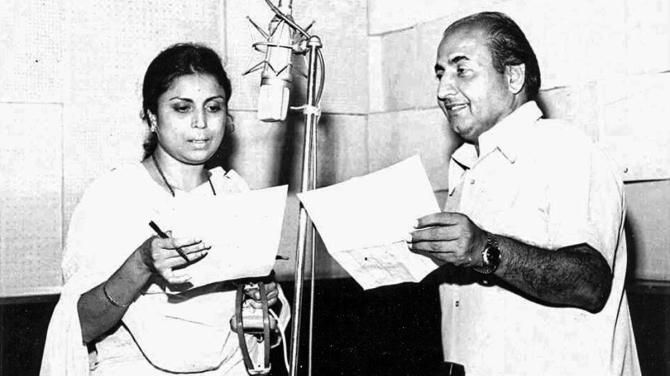

The passing of legendary playback singer Suman Kalyanpur at the age of 89 marks the end of a glorious chapter in Indian music. For millions of listeners, her voice remains intertwined with some of the most beautiful melodies of Hindi and Marathi cinema. Yet, despite possessing a voice of extraordinary sweetness and emotional depth, Suman Kalyanpur never received the same level of fame and public recognition as the legendary Lata Mangeshkar. Her journey remains one of Indian music’s most fascinating stories, a tale of immense talent, and understated greatness.
Born as Suman Hemmadi on 28 January 1937 in Dhaka (now in Bangladesh), she moved with her family to Mumbai during her childhood. Initially interested in painting, she studied at the prestigious Sir J. J. School of Arts while simultaneously receiving classical music training under renowned gurus. What began as a hobby soon transformed into a lifelong devotion to music. She entered the playback singing world in the early 1950s. She went on to record hundreds of songs in multiple Indian languages, including Hindi, Marathi, Gujarati, Bengali, Punjabi, and Kannada.
One of the greatest ironies of Indian film music is that countless listeners have spent decades believing many of Suman Kalyanpur’s songs were sung by Lata Mangeshkar. The similarity in their vocal texture often led to confusion. Songs such as “Na Tum Hamein Jaano“, “Aaj Kal Tere Mere Pyaar Ke Charche“, “Dil Ek Mandir Hai” and “Na Na Karte Pyaar Tumhi Se Kar Baithe” are among the many songs frequently mistaken for Lata’s voice. In reality, these timeless melodies showcased Sumanji’s own artistry and individuality.
Her contribution to Marathi music was equally remarkable. Marathi listeners continue to cherish songs such as “Limbonichya Jhadamage Chandra”, “Are Sansar Sansar”, “Ketakichya Bani Tithe”. This making her one of Maharashtra’s most beloved voices.
Perhaps the greatest testimony to Suman Kalyanpur’s talent lies in the fact that even today, countless music lovers who have been humming her songs for decades are unaware that they were listening to Sumanji and not Lata Mangeshkar.
There is a well-known anecdote from an Akashvani broadcast where a song sung by Suman Kalyanpur was announced as being sung by Lata Mangeshkar. On hearing the broadcast, Sumanji’s daughter reportedly contacted Akashvani to point out the mistake and inform them that the song had actually been sung by her mother. The incident beautifully illustrates both the extraordinary quality of Sumanji’s voice and the unfortunate reality that she often did not receive due recognition for her own work.
A question that has often puzzled music lovers is: why did Suman Kalyanpur not achieve the same stature as Lata Mangeshkar despite being equally gifted?
Several factors contributed to this. First, Lata Mangeshkar’s rise coincided with the golden age of Hindi cinema. During which she established an unparalleled relationship with the industry’s biggest composers and producers. By the late 1950s and 1960s, Lata had become the preferred voice for most leading actresses. Breaking such dominance was extraordinarily difficult for any singer.
Second, Suman Kalyanpur was known to be a private and reserved individual. Unlike many artists, she largely stayed away from publicity and industry politics. Her focus remained on music rather than self-promotion. This meant that while her songs became popular, her public persona never grew to the same extent.
Third, the very similarity of her voice to Lata’s became both a blessing and a burden. While it earned her opportunities, it also prevented many listeners from recognizing her unique identity.
Despite these challenges, her achievements were significant. She recorded approximately 740 songs and shared around 140 duets with Mohammed Rafi. Her collaborations with Rafi remain among the highlights of Indian playback singing.
Recognition eventually came, even if later than many admirers felt it should have. Suman Kalyanpur received the prestigious Sur Singer Samsad awards, the Lata Mangeshkar Award from the Government of Maharashtra, the Ga Di Ma Award, the Mirchi Music Lifetime Achievement Award, and, most notably, the Padma Bhushan in 2023—India’s third-highest civilian honour.
History may remember Lata Mangeshkar as the towering icon of playback singing, but it must also remember Suman Kalyanpur as a singer of extraordinary grace, refinement, and musical excellence. If fame did not fully reflect her talent, time certainly has. Her voice remains immortal not as “the other Lata,” but as the one and only Suman Kalyanpur, a melody that will continue to echo in Indian hearts for generations to come.
Share this:
- Share on Facebook (Opens in new window) Facebook
- Share on X (Opens in new window) X
- Email a link to a friend (Opens in new window) Email
- Share on LinkedIn (Opens in new window) LinkedIn
- Share on Reddit (Opens in new window) Reddit
- Share on Mastodon (Opens in new window) Mastodon
- Share on WhatsApp (Opens in new window) WhatsApp
- Share on Threads (Opens in new window) Threads
- Share on Pinterest (Opens in new window) Pinterest

