

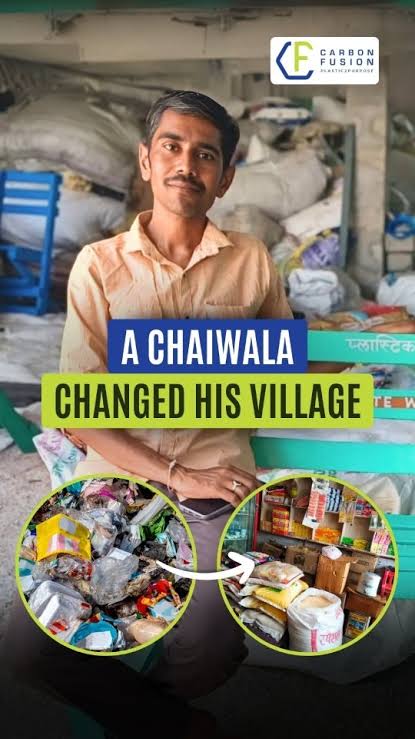


In a village in Rajasthan, a kilogram of discarded plastic can buy a kilogram of sugar. It is an unusual exchange, but for Kanaram Mewada, popularly known as Kanji Chaiwala, it has become a way to change how an entire community thinks about waste.
A tea seller by profession, Kanaram has turned his modest business into the starting point of an environmental movement. His mission is to keep plastic out of the streets, countryside and wildlife habitats surrounding Jawai, an area renowned for its leopard population.
Kanaram’s journey was not an easy one. He had dropped out of school after Class 10 and travelled to several cities looking for employment. After facing repeated disappointments, he returned to his village and opened a small tea stall. It was here that he began noticing a problem that others had simply learned to ignore. Customers would throw away plastic cups, biscuit wrappers and water bottles around his shop. Soon, the surroundings became littered, and the accumulated waste even produced an unpleasant smell.
Instead of waiting for local authorities to address the problem, Kanaram decided to do something himself. His initial efforts involved collecting plastic and encouraging people to keep their surroundings clean. But awareness alone did not work. People continued throwing plastic wherever they pleased.
He then came up with an unusual incentive. Initially, he offered a small plant or flowerpot for every kilogram of plastic collected. When the response remained limited, he changed his approach and began offering one kilogram of sugar in exchange for one kilogram of plastic. This simple barter system caught people’s attention.
He introduced campaigns such as ‘Plastic Laao, Inaam Paao’ (Bring Plastic, Get a Reward) and ‘Plastic Laao, Pencil Paao’ (Bring Plastic, Get a Pencil). People could exchange plastic waste for sugar, stationery, plants, notebooks and other household essentials. Gradually, women, children and entire families began participating.
Kanaram did not restrict his efforts to his tea stall. He began door-to-door collection, encouraged schoolchildren to gather plastic waste and arranged large collection bins in schools. He even organised an autorickshaw to collect discarded plastic from households.
What began as an individual effort gradually spread to neighbouring villages. Reports in 2023 recorded collections of around 200 kg of plastic every month. By 2025, his initiative had reportedly expanded to 15 villages, with more than 15,000 kg of plastic collected.
He also worked with social organisations to establish recycling facilities. The collected material was segregated and sent for processing, with some of it being converted into useful products such as benches, dustbins and tree guards. His efforts have helped bring attention to plastic pollution in the ecologically sensitive Jawai region, known for its leopards and other wildlife.
The road was not without resistance. His family initially worried that spending money and resources on the initiative could affect his livelihood. He also faced criticism and a lack of support in the beginning. Yet, he continued because he believed that someone had to take responsibility.
Kanaram now wants to extend the movement further and inspire young people to take ownership of environmental protection. He may have started out serving tea at a roadside stall, but his work has grown into something much bigger.
His story shows how an ordinary citizen, without a large organisation or institutional backing, can influence an entire community. Sometimes, the most meaningful environmental movements begin with something as simple as refusing to walk past a piece of discarded plastic.

