



Walk into a temple in Bali, a monastery in Kyoto or a royal ceremony in Bangkok, and you will hear words that sound familiar to an Indian ear. The East did not conquer India’s mind. It borrowed from India, by choice, over many centuries. That is why the word Guru still fits.
How Far Sanskrit Travelled
Sanskrit travelled by road, by sea and in the bags of monks and merchants. Buddhist monks carried it across Central Asia into China, Korea and Japan. Traders and priests carried it by ship to Java, Bali, Cambodia, Thailand and Vietnam. Old stone inscriptions in these lands are written in Sanskrit, and kings took Sanskrit names. Even today, Thai royal names and many Indonesian words come from Sanskrit.
Who Took It to China
The first well known Indian monks, Kashyapa Matanga and Dharmaratna, are said to have reached Luoyang around 67 CE. Later came Paramartha, Bodhidharma and many others. Kumarajiva, born in Central Asia to an Indian father, translated huge numbers of Sanskrit texts into Chinese. Then the flow reversed. Chinese pilgrims like Faxian and Xuanzang walked to India, studied at Nalanda and carried home hundreds of manuscripts. China was not a passive student. It was a hungry one.
Did Only Buddhism Leave India?
No. Buddhism was the biggest export, but it was not alone. Hindu gods, the Ramayana, the Mahabharata, temple building, astronomy, medicine and grammar also travelled. Angkor Wat in Cambodia was built for Vishnu. Hindu kingdoms rose in Java and Champa. The ideas went out as culture, not as armies.
Was Sea Travel a Sin?
Later Indian society did frown on crossing the ocean, the so called kala pani belief, because of fears about caste purity. But this came later. In earlier centuries Indian sailors, traders and priests crossed the seas freely. Hindus went abroad in large numbers, and the proof stands in stone across Southeast Asia.
One Story, Many Faces
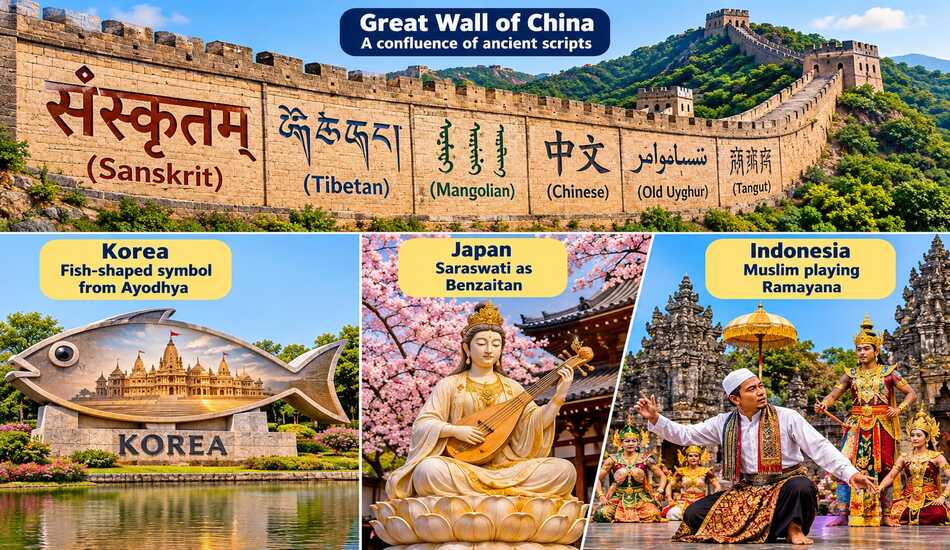
The Ramayana is played in Indonesia, the largest Muslim country in the world. Muslim artists perform it with pride, and the Ramayana ballet at Prambanan draws crowds. They see it as part of their heritage, not a threat to their faith. In Javanese tradition Hanuman is often shown with white colouring, because every land paints the story in its own colours. In Japan, Saraswati became Benzaiten, the goddess of music and learning, and she looks Japanese because Japan made her its own. Indian gods like Indra, Brahma and Ganesha also entered Chinese and Japanese Buddhism under new names. Sanskrit mantras are still chanted in these traditions, and Sanskrit inscriptions can be seen at the Juyongguan gate near the Great Wall, alongside four other scripts.
A Korean Queen from Ayodhya
An old Korean chronicle, the Samguk Yusa, tells of Queen Heo Hwang ok, a princess from a land called Ayuta who sailed to Korea in 48 CE and married King Suro. Many Koreans trace their family roots to her, and Ayodhya and the Korean city of Gimhae have formed a bond because of her. Historians call it legend mixed with memory, but the fact that Korea keeps it alive says something about how it views India.
Why India Wrote Little History
India did write history, such as Kalhana’s Rajatarangini, but it did not keep the habit of royal chronicles that China did. Indian thinkers cared more about dharma, philosophy and story than dates. So we often learn about ancient India from the diaries of visitors like Xuanzang, Faxian and Megasthenes. That is a gap we should admit honestly.
Did India Never Attack Anyone?
Mostly, India spread ideas rather than armies. But it is wrong to say never. The Chola king Rajendra sent a naval expedition against the Srivijaya empire around 1025 CE. A fact checker must say so. Still, India never ran a long colonial empire overseas. The scholar Hu Shih is often quoted as saying India conquered China culturally for twenty centuries without sending a single soldier. The quote is famous, though its exact wording is debated.
Is Sanskrit the Mother of All Languages?
Not exactly. Sanskrit is a very old and very rich sister of Greek, Latin, Persian and the Germanic languages, all descended from a still older source scholars call Proto Indo European. Tamil, Telugu, Kannada and Malayalam belong to a different family, the Dravidian one, although they borrowed much from Sanskrit. Sanskrit was a language of scholars, priests and courts across Asia for a thousand years, so in that sense it was a global language of learning. English hides it in plain sight: mother and matar, father and pitar, name and naman, nine and nava, door and dwar.
Do the Chinese Still Love India?
It is mixed. Governments compete and quarrel over borders. But ordinary people still respect India as the land of the Buddha, and Xuanzang is a hero in Chinese schools. Tagore was admired in China. The old respect is real, though modern politics often hides it.
Is Their Buddhism Just Fashion?
That would be unfair. Buddhism is deeply rooted in China, Japan, Korea, Thailand and Sri Lanka. Millions practise it seriously, and monasteries keep ancient rules. Thai kings still use sacred water, including Ganga water, in coronation rites. This is devotion, not decoration.
The Constitution as a Living Text
India also gave itself something new. The Constitution, brought to life in 1950, was like a prana pratishtha, a life breathed into an idea of a free and equal people. Its strength depends on whether citizens keep that life alive.
What We Have Forgotten
Here is the sad part. The East remembers India better than India remembers itself. Our children rarely learn that Indian ideas shaped half of Asia. Sanskrit is treated as a dead subject, though it trains the mind with its exact grammar, created by Panini, and gives children a window into maths, logic, poetry and philosophy. Learning it does not mean rejecting English or any other language. It means knowing our own roots.
India is Guru in the East not because it ruled, but because it gave. If we want that respect to last, we must keep learning, keep telling the truth about our past, and keep giving.


Very nicely studied and perfectly explained.
Your depth of study is great. To gather detailed information about everything is superb.
Thanks for your blog.
What a simple but comprehensive write up on the glory that we know as Bharat. Living abroad, especially in the African continent, i have realized how lucky we Indians are that we have such an illustrious and rich history – not many countries can boast of this. Always was and always will be proud to be called an Indian.