

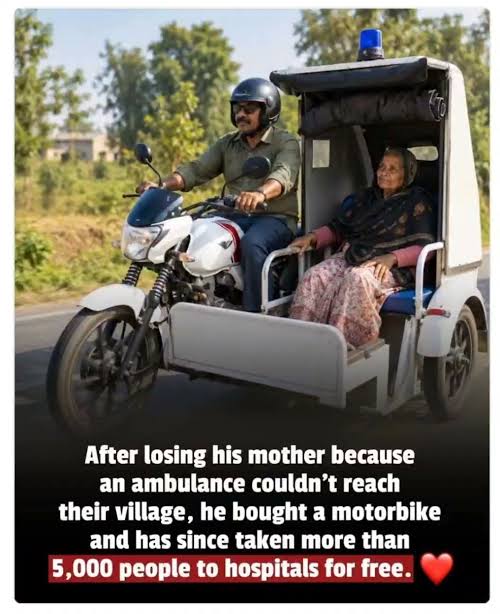


In the remote villages of Jalpaiguri district in West Bengal, where hospitals are far away and ambulances are often difficult to access, one man’s motorcycle has become a lifeline for thousands. His name is Karimul Haque, lovingly known as Bike Ambulance Dada.
A tea garden worker by profession, Karimul did not begin with an organisation, financial support or medical infrastructure. He began with a personal tragedy that he could never forget.
In 1995, his mother, Zafuran Nessa, suddenly fell seriously ill during the night. Desperate to get her medical attention, Karimul and his family went from door to door seeking help and trying to arrange transport to the nearest hospital, more than 40 kilometres away. But no ambulance was available. His mother died without receiving timely medical treatment.
Her death left him devastated. But instead of allowing his grief to end there, he made a promise: no one else in his village should have to lose a loved one simply because there was no way to reach a hospital.
A Motorcycle With a Purpose
A few years later, an incident at the tea garden changed everything. A fellow worker suddenly collapsed and needed urgent medical attention. There was no ambulance available.
Remembering his mother’s death, Karimul decided he could not stand by helplessly. He placed the unconscious worker on his back, secured him with a piece of cloth and rode nearly 45–50 kilometres to reach a hospital. The worker survived.
That experience gave Karimul an idea. If an ambulance could not reach these villages, perhaps his motorcycle could take patients to medical help.
He began using his motorcycle to transport sick and injured people to hospitals, without charging them anything. Initially, people laughed at him, unable to understand why a man with limited means would take on such a responsibility. But he continued.
Over time, his motorcycle evolved into a modified ambulance, equipped with a sidecar stretcher, an oxygen cylinder arrangement and basic first-aid supplies. He also received guidance and training from doctors to provide basic assistance during emergencies.
Thousands of Lives, One Promise
Karimul’s service gradually became a lifeline for more than 20 remote villages in the Dooars region. Many of these communities have poor road connectivity, limited healthcare facilities and hospitals several kilometres away.
He has travelled through difficult roads, forests and challenging terrain, often responding to emergency calls in the middle of the night. Whether it is an accident victim, a pregnant woman or someone suddenly taken seriously ill, he has made himself available to those in need. And he has never charged patients for these journeys.
By 2017, reports had recorded that he had transported more than 3,000 patients. Later accounts put the number above 5,500, and reports in 2026 noted that he had helped more than 6,500 patients.
But his contribution extends beyond emergency transport. He has also helped organise health camps, provided basic first aid and worked towards improving access to healthcare for tribal communities. His sons have joined him in this mission, helping carry forward the service.
The Padma Shri and a Legacy of Compassion
In 2017, the Government of India honoured Karimul Haque with the Padma Shri, the country’s fourth-highest civilian award, for his extraordinary contribution to society.
His story also inspired the 2021 biography Bike Ambulance Dada, written by Biswajit Jha. He was featured on Kaun Banega Crorepati in 2021, bringing his work to a much wider audience.
For someone who once struggled to find an ambulance for his own mother, the recognition was remarkable. Yet, the real achievement lies in the thousands of families who found help when they needed it most.
Karimul Haque may have started with just one motorcycle, but he built something far greater: hope for communities that had long struggled to access medical care.
His story reminds us that we do not always need enormous resources or powerful positions to make a difference. Sometimes, all it takes is the willingness to ensure that someone else does not suffer the helplessness we once experienced.
He could not save his mother. But he turned that loss into a promise that has helped thousands of other families.

