

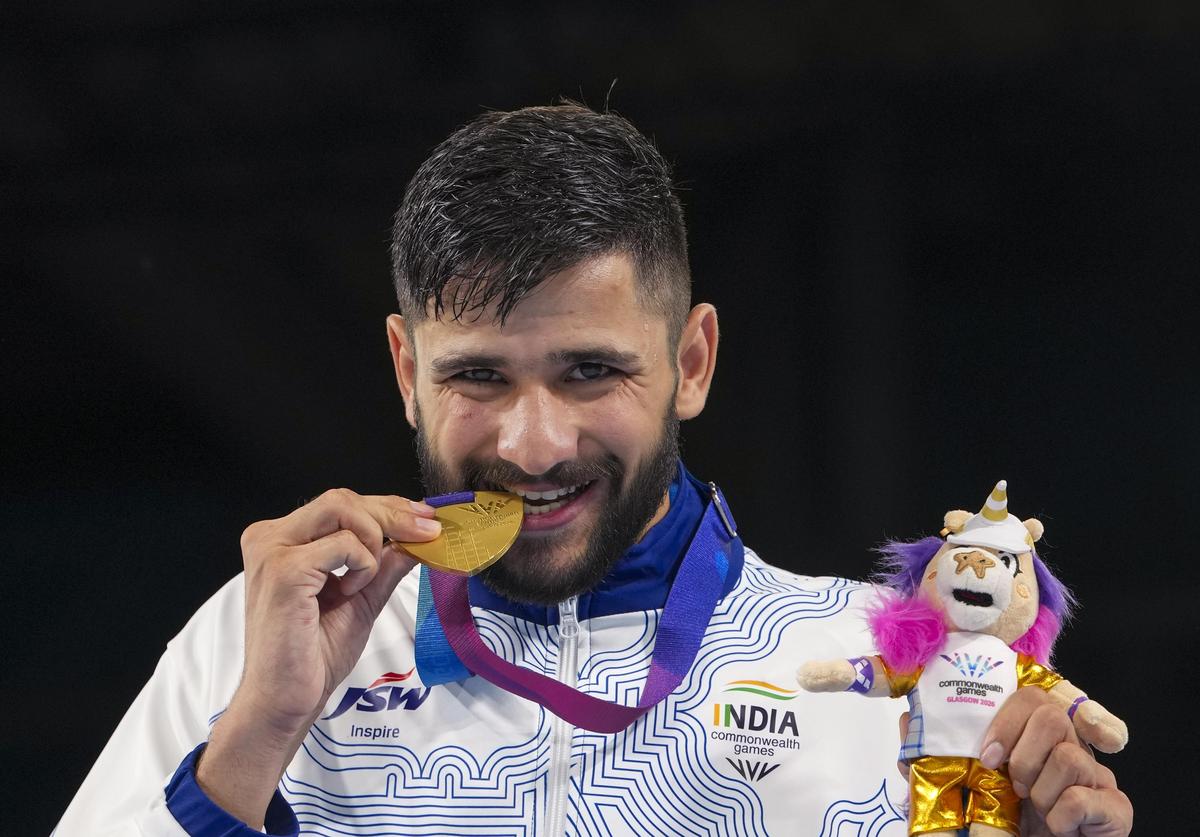


Before Sachin Siwach learned how to win boxing bouts, he had to fight for something much simpler the chance to become a boxer.
When his father, Krishan Siwach, took his 10-year-old son to the Captain Hawa Singh Boxing Academy in Bhiwani in 2009, coach Sanjay Sheoran initially refused to enrol him. Sachin was undernourished and simply didn’t look ready for the demands of boxing. But his father persisted, and Sachin eventually got his chance.
Getting into the academy was only the beginning. The training diet recommended for Sachin included milk, almonds, fruits and other nutritious food things his farming family could barely afford. Then, unexpectedly, a stray cow wandered into their village. Sachin’s father took it home, and the milk helped solve the immediate problem. It sounds like a small detail, but it says a lot about the kind of family behind Sachin’s journey: when money wasn’t available, they found another way.
Sachin kept boxing. The boy who had once been considered too weak for the academy began beating boxers on bigger stages. In 2015, he won a bronze at the Junior World Championships. A year later, he went a step further, winning gold at the 2016 Youth World Boxing Championships in St Petersburg, becoming only the third Indian boxer to win a youth world title.
There were more medals and more setbacks after that. Sachin won gold at the Commonwealth Youth Games and South Asian Games, competed internationally and gradually established himself in senior boxing. But the road wasn’t smooth. He had to keep proving himself in a sport where one poor performance can push an athlete out of the picture.
His breakthrough at the senior level came in 2025 when he won the World Boxing Cup Finals, becoming the first Indian male boxer to claim that title.
Then came Glasgow. At the 2026 Commonwealth Games, Sachin made his debut in the men’s 60 kg category. He kept moving through the tournament until he reached the final against Botswana’s Tryagain Morning Ndevelo. The final tested everything he had learnt over the years.
Sachin was behind after the opening rounds, but instead of allowing the fight to slip away, he turned it around in the final round. The judges gave him a 3-2 split-decision victory, and Sachin Siwach became the Commonwealth Games champion.
The image of Sachin holding the gold medal in Glasgow tells you how the story ended. It doesn’t tell you about the 10-year-old who was once considered too undernourished to enter a boxing academy. It doesn’t tell you about a farmer father trying to provide the food his son needed, or the unexpected cow that became part of his boxing journey. But perhaps that’s what makes the Glasgow victory special.
Sachin didn’t arrive at the Commonwealth Games as a finished champion. He arrived carrying every small fight that had brought him there and when the biggest fight of his career demanded one more comeback, he simply did what he had been doing since he was ten: he found a way.

