

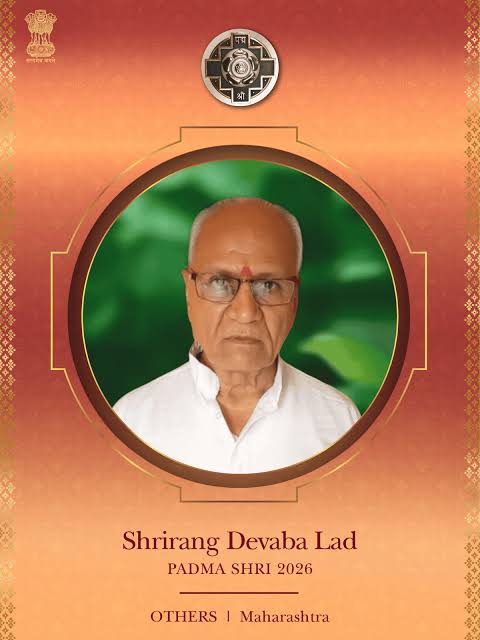


In the drought-prone fields of Parbhani, Maharashtra, Shrirang Devba Lad learned an important lesson early: when farming fails, the consequences are not measured only in numbers. They are felt in homes.
For decades, Lad watched farmers struggle with low yields, rising costs and uncertain weather. Instead of accepting these difficulties as inevitable, he began looking for answers in the fields themselves.
Born on 1 January 1947 in Malsonna village of Parbhani district, Lad completed his college education at Shitaji College, Parbhani. His life took an unusual path after his studies. He worked as a social worker and RSS pracharak from 1969 and later became associated with the Bharatiya Kisan Sangh, while continuing to remain deeply connected with rural communities. During the Emergency, he also worked underground on social-awareness activities.
Agriculture remained his laboratory. Lad began experimenting with cotton cultivation, observing how plants responded to spacing, pruning and the management of their growth. He gradually developed what came to be known as the Dada Lad Technique.
The idea was deceptively simple. Instead of allowing cotton plants to grow unchecked, the method uses closer planting, removal of non-fruit-bearing branches and topping of the plants at the appropriate stage. The aim is to direct the plant’s energy towards fruit-bearing branches and cotton bolls. Water and soil-moisture management are also part of the approach. ICAR has studied the technique and, in 2021, its Director General visited demonstration plots in Maharashtra, noting its potential to substantially increase cotton productivity in irrigated areas.
The results attracted attention.
The Government of India’s Padma citation records that farmers traditionally producing around 5–6 quintals of cotton per acre were able to reach 25–30 quintals per acre using Lad’s technology in reported trials. His techniques also produced substantial increases in jowar yields, and his agricultural work was evaluated by the Central Institute for Cotton Research, Nagpur.
Lad’s work was never limited to his own fields. He travelled, demonstrated his methods and encouraged farmers to experiment. By 2021, ICAR reported that the technique had already been adopted by around 700 farmers in parts of Maharashtra.
His concern for agriculture also extended beyond crops. Lad has worked for the conservation of indigenous cattle breeds, including Lal Kandhari, and remained involved in farmer organisations and grassroots agricultural initiatives.
In December 2025, Vasantrao Naik Marathwada Agricultural University honoured him with an honorary Doctor of Science degree.
Then came the recognition that put his decades of fieldwork on the national stage. In January 2026, the Government of India announced Shrirang Devba Lad as a Padma Shri recipient in the category “Others – Agriculture.”
For a farmer who spent decades treating his fields as a place for questions, experiments and solutions, the honour recognised something larger than one technique: the value of knowledge created by farmers themselves.

