

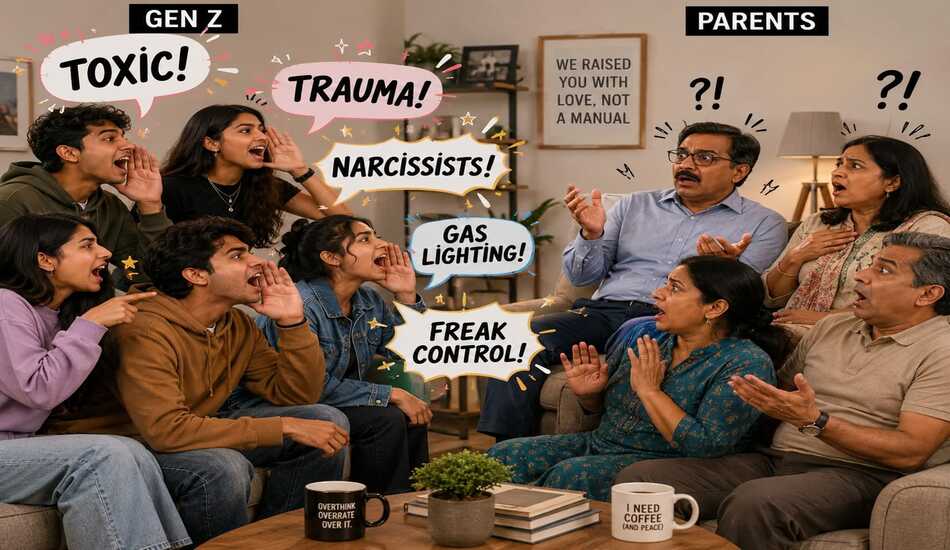


WHY CHILDREN ARE EMOTIONALLY CUTTING OFF FROM FAMILY
There is a quiet crisis happening in Indian homes today. Children, grown-up children, teenagers, and young adults, are emotionally disconnecting from their parents. They are not running away. They are not fighting loudly. They are just going silent. They are building invisible walls. And both parents and children are confused about why.
Let us try to understand that silence.
Two Generations, Two Wounds
Let us start with the older generation, our parents and grandparents. They grew up in a world where family was everything. But in that world, expressing emotions was rare. Parents worked hard, gave food, clothes, and shelter, but rarely said “I love you”. Children were left alone with their feelings. Nobody asked how they felt. Nobody sat with them when they were sad.
This generation was hurt by abandonment, not physical abandonment, but emotional abandonment. They were present in the house but absent in the heart.
Now comes the next generation, today’s parents who are raising Gen Z children. They remembered their own childhood pain. They said to themselves, “I will not repeat what was done to me. I will be involved. I will be present. I will care.”
And they did. Very much so.
But somewhere, involvement crossed a line. Presence became watching every move. Caring became controlling. These parents checked every choice, friends, career, clothes, relationships, screen time, and food. Their children could not breathe freely.
This generation of children is hurt by suffocation, not from lack of love, but from too much control in the name of love.
Two generations. Two opposite wounds. Both caused by love that went wrong.
The Real Difference: Intent
Here is the most important point of this discussion, and it is easy to miss.
The older parents who were emotionally absent were not doing it with bad intentions. They simply did not know better. Emotional parenting was never taught to them. It was never shown to them. They gave what they had, which was physical security.
Similarly, today’s controlling parents are also not doing it with bad intentions. They are doing it out of fear, fear of the world, fear of failure, fear of losing their child. Their intent is love. Their method is wrong.
So when a child calls their parent “toxic” or “narcissist” or “control freak”, they may be describing a real feeling. But they may be misunderstanding the intent. The parent is not an enemy. The parent is a hurt person, doing their best with limited tools.
The Language Problem
This brings us to a very important point, the role of language.
Today, clinical psychological words have entered daily conversation. Words like toxic, narcissist, gaslighting, control freak, and trauma were once used carefully by trained therapists. Today, they are used casually on Instagram reels, YouTube shorts, and WhatsApp forwards.
When a teenager watches a five-minute reel about “signs your parent is a narcissist”, they start applying that label to their own mother or father. One argument, one rule, one moment of anger gets labelled as a serious mental health issue.
The danger is this: language shapes thought. Once you start calling your parent a narcissist, you stop seeing them as a human being with flaws and fears. You start seeing them as a problem to be managed or escaped from.
Emotional cutoff then feels not just justified, but necessary. Even healthy.
Separation Is Not Always the Solution
This discussion makes a vital point here. Emotional distance is sometimes shown online as the best form of self-care. “Cut off toxic people, even if they are family.” This sounds powerful. But it skips the harder work.
Real emotional health is not built by cutting everyone off. It is built by learning to hold boundaries while staying in relationship. By talking openly. By accepting discomfort. By understanding that love and pain can exist together in the same person.
The Way Forward
Children need to see their parents as full human beings, not just as roles. Parents need to learn that love without freedom is not love, it is fear.
The bridge between these two generations will not be built by one side winning the argument.
It will be built when both sides learn one simple skill, listening without defending.
That is where healing begins.


Very true. Today’s Generation is very touchy and different from what we were in our childhood. With the information and Social Media availability, today’s Generation is very much aware of all aspects of life.But still they want to have their private and personal space.
A very good attemp in describing the challenges of both the phase.
Thank you for reading and sharing your thoughts. Your comment means a lot to me.. 🙏