

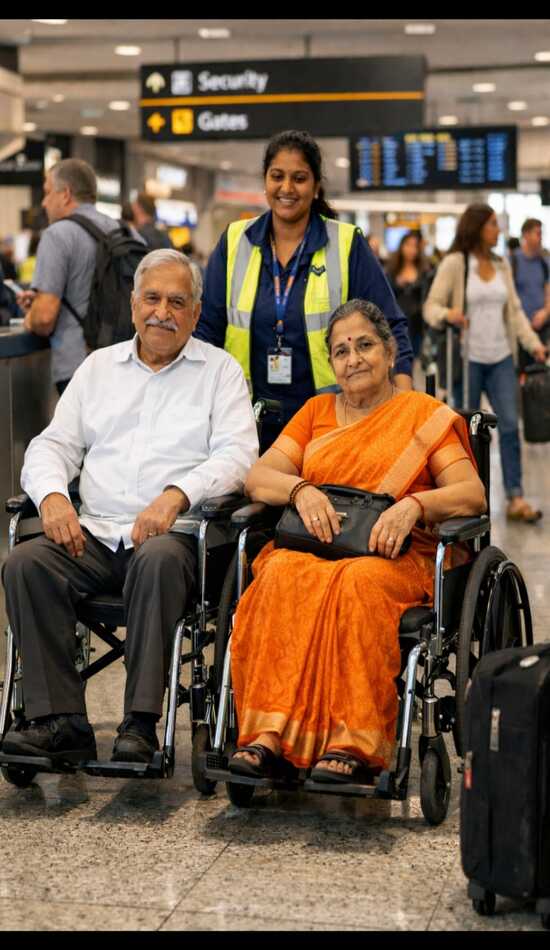


The Wheelchair Trend at Airports: A Question of Civic Responsibility
Airports are stressful places everywhere in the world. Long queues, security checks, immigration procedures, and crowded terminals can test anyone’s patience. But in recent years, a worrying trend has emerged at some Indian international routes — a surprisingly high number of passengers booking wheelchair assistance.
According to reports attributed to CISF in 2024, nearly 12% of Indian travellers requested wheelchair assistance at airports. On certain long-haul routes like Chicago and New York, the number was reported to be as high as 30%. While many passengers genuinely need mobility support, it is difficult to believe that such a large percentage cannot walk independently.
Airlines have repeatedly requested passengers not to misuse wheelchair services, which are meant for elderly travellers and people with genuine disabilities. Unfortunately, social media posts often show people treating this as a “clever hack” to avoid long walks and lengthy procedures.
Why does this happen?
One explanation lies in human psychology. When the benefit is high, the cost of cheating is low, and enforcement is weak, even otherwise moral individuals may justify bending the rules. Some may convince themselves that they are “temporarily unwell” or simply using a facility that is available.
There is also a deeper social factor. In societies shaped by resource constraints, heavy competition, and population pressure, people sometimes develop what psychologists call a “scarcity mindset.” When systems feel slow or unfair, individuals may think, “If I don’t take advantage, someone else will.” In that mindset, misusing a wheelchair is not seen as harming someone else, but as beating an inefficient system.
Indian airports can also be physically demanding. Long distances between terminals, multiple security checks, removal of personal items at screening, repeated document verification, and outdated procedures make the journey exhausting. Faced with this, some passengers ask themselves, “Why walk when I can roll?”
However, the real victims of this behaviour are passengers with genuine disabilities. When services are overbooked, those who truly need assistance may face delays. Worse, repeated misuse can reduce empathy among airport staff, causing suspicion toward even legitimate requests.
This behaviour is not uniquely Indian. Any overcrowded society with weak enforcement and low public trust can display similar tendencies. But India’s size and visibility make such incidents more noticeable on the global stage.
As India modernises its infrastructure, civic responsibility must grow alongside it. Following rules should not feel foolish, and breaking them should not feel clever. Stronger enforcement may help, but long-term change requires awareness and a sense of fairness.
Wheelchair services exist for those who truly need them. Respecting that is not just about airport etiquette — it is about basic empathy and national character.


Frankly speaking this happens everywhere specially in india because of very high population and indian mentality.
It may take more than 100 years to improve such mind set and mentality of everybody.
Social awareness is very low. Lots of factors involved in such areas.
“Absolutely agree! The issue is complex, and changing mindsets takes time. Raising social awareness and addressing the root causes can help shift perspectives..