

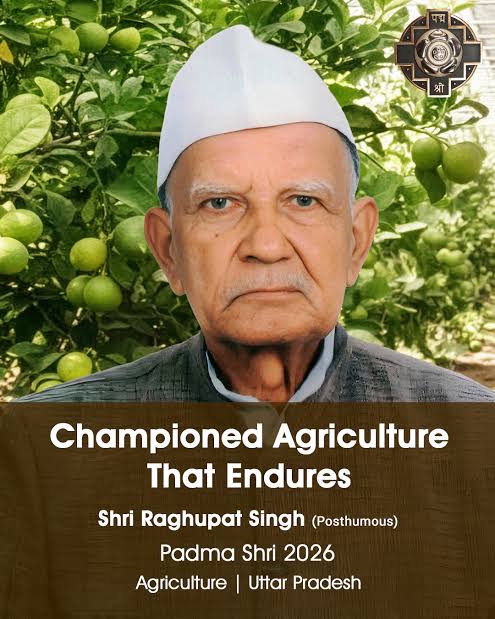


In Samathal village of Bilari, Moradabad, Raghupat Singh was known simply as a farmer. But for more than five decades, his fields were doing something far bigger than producing crops. They were preserving pieces of India’s agricultural heritage.
Born on 27 October 1944 into a farming family, Singh learned the basics of agriculture from his father, who had deep knowledge of farming. He studied at the village school before pursuing higher education an M.A. in Geography, an M.A. in Political Science and later an LL.B. But despite his education, he remained closely connected to the land.
The early years were not easy. Singh owned only about 1.5 hectares of land, and traditional farming had once made it difficult for his family to make ends meet. Instead of abandoning farming, he began looking for ways to make a small farm more productive. He learnt from ICAR institutes and Krishi Vigyan Kendras and began experimenting with diversified farming and improved varieties.
Then he noticed something disappearing quietly from Indian fields and kitchens: traditional crops and vegetable varieties. Around the 1980s, he began collecting old seeds, growing them, selecting the better plants and preserving their seeds for the next season. He eventually conserved more than 55 rare and nearly extinct vegetable varieties and developed around 100 new varieties and improved selections. His work covered pulses, oilseeds, wheat, rice, rajma, lentils, vegetables and fruit trees.
His experiments produced remarkable results. He developed several rajma varieties and a bottle gourd that could grow to around 1.5 metres. He also worked with long-podded cowpea and numerous vegetable varieties. The aim was not novelty for its own sake; Singh experimented with crops that could work for farmers in local conditions.
What he learned, he shared. Reports say he trained and guided nearly three lakh farmers, while his family says he provided seeds to smaller farmers at free or minimal cost. He also became involved in agricultural programmes on Akashvani Rampur and was given the title “Krishi Pandit.” During his lifetime, he received 13 national awards and 18 awards from the Uttar Pradesh government, according to the official Padma citation.
Agriculture was also a family affair. His wife, Premwati, stood beside him, while their sons followed the same path. His three sons are involved in progressive farming and have continued his agricultural experiments and seed work.
Singh died in his village on 1 July 2025. Seven months later, his name appeared among the Padma Shri awardees for 2026, posthumously, for his contribution to agriculture and traditional seed conservation. In June 2026, his wife Premwati received the Padma Shri at Rashtrapati Bhavan, with their son Surendra Pal Singh accompanying her.
He spent his life collecting what others might have overlooked: a seed, a forgotten variety, an old farming practice. By the time he was gone, those small things had become a legacy shared by generations of farmers.

