

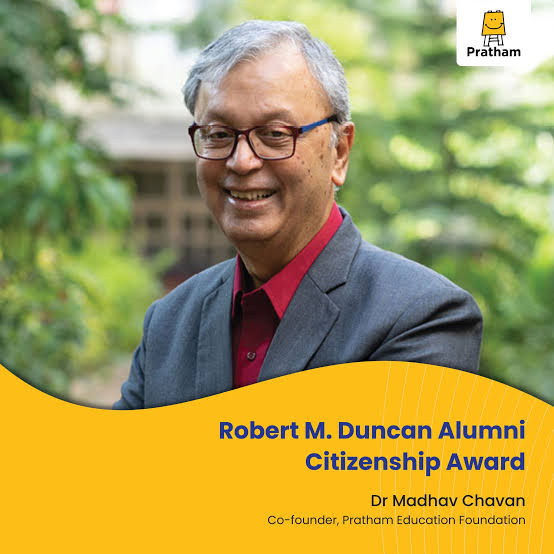


For Dr. Madhav Chavan, a career in chemistry seemed like the natural path. He had earned a PhD in Chemistry from Ohio State University and had taught in the United States. But when he returned to Mumbai, another question began troubling him: what happened to children who never had a real chance to learn?
Born in Maharashtra in 1954, Chavan grew up as an only child in a politically active family. His father, Yashwant Chavan, was a communist and trade unionist, and their home in Mumbai often doubled as a meeting place for activists and colleagues. He grew up surrounded by conversations about inequality, justice and social change.
Chavan studied chemistry at the Institute of Science in Mumbai, completing his MSc in 1978, and earned his PhD from Ohio State University in 1983. After post-doctoral work and teaching in the United States, he returned to India in 1986 to teach and conduct research. Then came the turn that changed his life.
In 1989, Chavan began working on adult literacy in Mumbai’s slums as part of the National Literacy Mission. He saw that simply putting children into schools was not enough. Many were attending school but were still unable to read or do basic arithmetic. The problem was not only access to education, but whether children were actually learning.
His work eventually brought him into a UNICEF-supported initiative focused on universal primary education in Mumbai. In 1994–95, Chavan and social worker Farida Lambay co-founded Pratham, with support from UNICEF and the Mumbai municipal system. The idea was simple but ambitious: bring education into communities and find ways of reaching children at scale without depending on expensive infrastructure.
Pratham began with community-based preschool programmes and gradually expanded into remedial education, programmes for children outside school, youth skilling and large-scale learning initiatives. Its Read India campaign focused on basic reading, writing and arithmetic, while the Annual Status of Education Report, or ASER, helped shift attention from school enrolment to what children could actually learn and do.
What began in Mumbai eventually grew across India. Pratham’s approach emphasised community participation, low-cost models and methods that could be replicated on a large scale. Its Teaching at the Right Level approach grouped children according to their learning level rather than simply their age or grade, and the model has subsequently been used in other countries.
Chavan stepped down as Pratham’s CEO in 2015 but remained involved with the organisation and its educational experimentation. His work brought international recognition, including the Skoll Award for Social Entrepreneurship in 2011 and the WISE Prize for Education in 2012.
From chemistry laboratories to Mumbai’s slums, Chavan changed the question he was trying to answer. It was no longer simply how to teach. It was how to make sure that a child, wherever they began, actually learned.

