

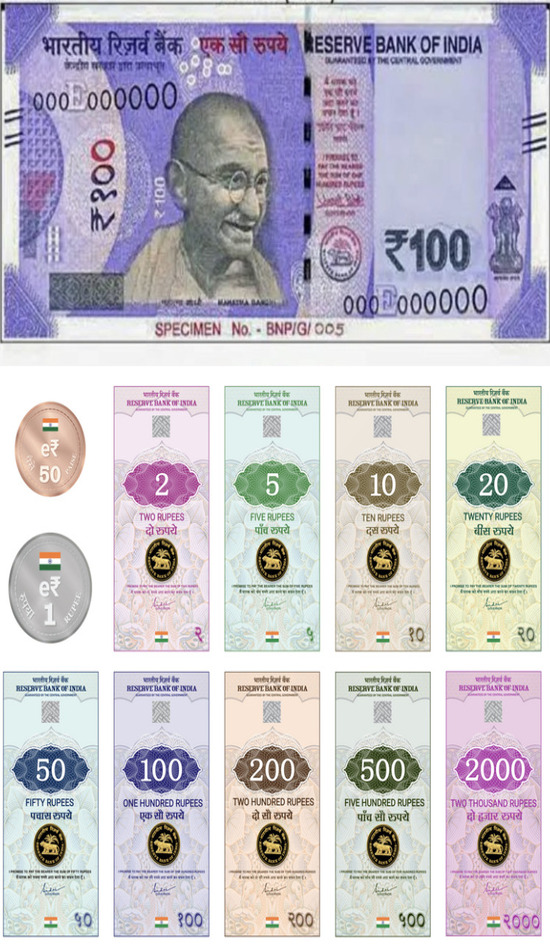


A Tribute to Gandhi ji: A Fading Moral Compass
Dear Bapu ji,
Everyday, your face reminded us of truth, peace, and sacrifice, silently watching over every exchange of value in our lives. You weren’t just on our currency; you were in our conscience, a symbol of integrity behind every note we held.
As we move toward the digital age, your absence feels deeply personal – as if a part of our moral compass is fading from our fingertips. For decades, our worth was counted in “Gandhi’s notes,” but their true value was never just money – it was the message of simplicity and honesty you stood for.
We miss you, Gandhi ji.
Sincerely,
On behalf of Indians nationwide
My bond with Bapu – I was sixteen when I first saw him depicted on our currency notes (1969, on Mahatma Gandhi’s birth centenary). Holding it in my hand and keeping it safely in my pocket filled me with respects. Now I’m overwhelmed with emotion saying goodbye to Bapu ji. ‘Meetings give us pleasure, and partings give us pain’ – a touching truth that echoes my feelings.
The Story of Mahatma Gandhi’s Portrait on Indian Currency
When India gained independence in 1947, the country inherited not just the legacy of British rule but also its currency system. The Indian rupee at that time still bore the portrait of King George VI, a visible reminder of colonial authority. Transitioning from the British era to a sovereign identity was not merely about political freedom—it was also about symbols, and currency became one of the most powerful tools to express that new national spirit.
1947–1949: The First Indian Currency
In the immediate aftermath of independence, India continued to use the British-era notes as a temporary measure. The Government of India, however, quickly set to work designing its first truly Indian series.
In 1949, the first ₹1 note was issued, marking the beginning of India’s independent currency. This note replaced the British monarch’s image with the Lion Capital of Ashoka from Sarnath, a symbol chosen for its deep historical and cultural significance. The Ashoka emblem stood for peace, courage, and righteousness—qualities the new Republic wanted to project to its citizens and to the world.
1950s: Animals, Agriculture, and Nation-Building
With the new Republic established in 1950, a fresh series of notes was introduced—denominations of ₹2, ₹5, ₹10, ₹100, and later ₹1,000. These designs reflected a nation in the midst of rebuilding and redefining itself.
The reverse sides of these notes carried motifs of Indian wildlife and agriculture—the tiger, deer, and elephant—representing strength, grace, and the richness of the land. These images aimed to celebrate India’s natural heritage and align currency with the country’s identity as a self-reliant agrarian economy.
This period also saw Indian artists and engravers, under the guidance of the Security Printing and Minting Corporation of India (SPMCIL) and the Nasik Security Press, taking on the creative responsibility for note design—a symbolic shift from British designers to Indian hands.
1969: The Gandhi Centenary and a Turning Point
Although Mahatma Gandhi was the moral face of India’s freedom struggle, his portrait did not appear on the currency for the first two decades after independence. The idea of including Gandhi’s image gained prominence around 1969, the centenary of his birth.
The Reserve Bank of India (RBI) issued a special ₹100 commemorative note featuring Gandhi at the Sevagram Ashram, to mark the occasion. This was the first time his image appeared on an Indian banknote, symbolizing a deeper recognition of his philosophy and contribution to the nation.
1987: The Gandhi Series—A Permanent Place
Nearly two decades later, in 1987, the RBI officially introduced the Mahatma Gandhi Series of banknotes. The first denomination to carry his smiling portrait was the ₹500 note, a new high-value denomination at the time. The photograph used was based on an actual image of Gandhi taken by an unknown photographer in 1946 at Rajghat.
This series replaced the earlier designs featuring the Ashoka Pillar on the obverse. Gandhi’s inclusion was not only a tribute but also a conscious design choice—his image represented truth, simplicity, and unity, values the nation wanted to enshrine in daily life.
1996 Onwards: The Modern Redesign
In 1996, a redesigned Mahatma Gandhi Series (New) was launched, expanding Gandhi’s image across all denominations—from ₹10 to ₹1,000. These notes introduced enhanced security features like watermarks, latent images, and micro-lettering to combat counterfeiting.
Each note’s reverse depicted themes of India’s progress—agriculture, technology, education, and heritage—mirroring the country’s aspirations in a rapidly changing world.
2016: The New Gandhi Series
Following demonetization in 2016, the RBI released a new Mahatma Gandhi (New) Series, starting with redesigned ₹500 and ₹2,000 notes. These new notes presented a younger image of Gandhi, updated typography, and vibrant color palettes. Each denomination highlighted India’s rich cultural and scientific landmarks—from Mangalyaan to Rani Ki Vav, symbolizing innovation alongside heritage.
Why the Digit Rupee Doesn’t Feature Gandhi’s Portrait
The arrival of a digital Central-bank currency ( CBDC) in India- often called the e-Indian Rupee or digital rupee -introduces a different paradigm from physical banknotes. Several notable reasons emerge for why Gandhi’s photograph has not been included in digital-rupee design:
1.Nature of medium-
Physical currency notes carry portraits, motif, tactical and optical security features. A digital currency token is virtual or not geographic.
2. Focus on technology & interoperability
The digital rupee emphasizes back- end ledger security, tokenization, ease of settlement; desi choices such as a portrait may be considered secondary or unnecessary.
3. Avoid overload of symbolism–
Since physical notes already feature Gandhi, the designers may have judged that the digital form doesn’t require the same symbolic imagery.
4.Legal / taxonomy differences
Digital currency is regulated differently; design templates may focus on logos, denominations, security devices rather than portraits.
5.Transitional nature –
The digital rupee is in a
pilot) roll-out phase; given the evolving framework, permanent imagery may yet not be finalised.
6.Deliberate choice–
Some reports suggest that Gandhi’s great- grandson expressed disappointment at the omission, implying the design team chose not to include the portrait in the digital variant.
Reference
India to Launch RBI-Backed Digital Currency in 2026

