

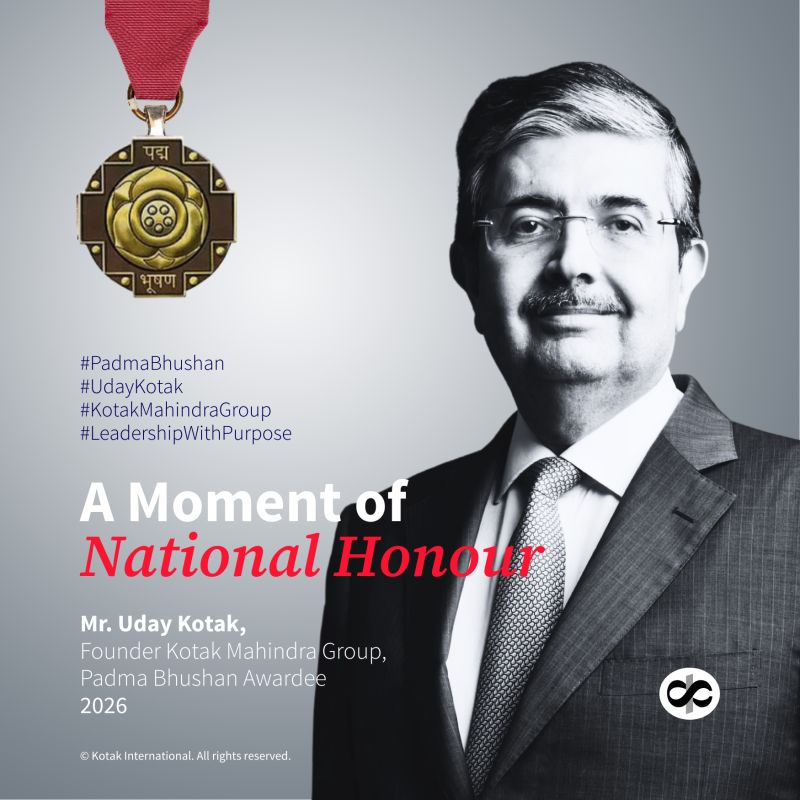


Uday Kotak’s journey began in a traditional Gujarati business family in Mumbai, where joining the family trade was an obvious choice. But he imagined a different future, not in trading, but in finance. That decision would eventually reshape India’s private banking landscape.
Born on 15 March 1959, into a Gujarati Hindu Lohana family, Kotak grew up in a large joint family where business, discipline and financial prudence were part of everyday life.
His father, a trader, ran a family business that dealt in commodities. Yet Uday wanted to build something of his own. He studied commerce at Sydenham College and later completed his management education at Jamnalal Bajaj Institute of Management Studies in Mumbai.
His early life was not without challenges. An avid cricket player, he suffered a serious head injury during a game that required surgery and interrupted his sporting ambitions. The experience reinforced the importance of discipline and resilience, qualities that would later define his professional life.
From ₹30 Lakh to a Banking Empire: In 1985, after completing his education, Kotak started a small financial services business, initially focused on bill discounting and money-market activities. Rather than join the family enterprise, he chose to take the entrepreneurial risk himself.
It was a time when India’s financial sector was tightly regulated, and private banking opportunities were limited. Building credibility, attracting capital and earning the trust of businesses required patience. Kotak concentrated on understanding customers’ financial needs and creating services around them.
An important partnership came with Anand Mahindra, whose group invested in the business. What began as Kotak Capital Management Finance gradually expanded into a broader financial services enterprise. The partnership helped the business grow, although Kotak remained the driving force behind its development.
Over the years, the company moved beyond bill discounting into car finance, investment banking, insurance, stockbroking and asset management. Instead of relying on a single source of income, Kotak built a diversified financial institution.
A Turning Point for Indian Banking: In 2003, Kotak Mahindra Finance made history when the Reserve Bank of India granted it a banking licence. It became the first Indian non-banking financial company to convert into a commercial bank. This was a significant milestone for India’s financial system, demonstrating that a home-grown financial services company could evolve into a regulated bank.
As Kotak Mahindra Bank expanded, it brought banking, lending, investments and other financial services under one institutional umbrella. Its growth contributed to greater competition in private banking and widened the range of financial services available to Indian consumers and businesses.
Kotak also built a reputation for conservative risk management, strong capital discipline and caution during periods of financial uncertainty. These principles helped the institution navigate difficult market cycles, although, like other large banks, it faced regulatory scrutiny and operational challenges along the way.
Beyond the CEO’s Chair: Beyond building his banking empire, Uday Kotak played a significant role in strengthening India’s financial governance. In 2017, the SEBI-appointed committee he led recommended major reforms to improve corporate governance and transparency. From 2018 to 2022, he chaired the government-appointed board tasked with steering crisis-hit IL&FS through its financial turmoil.
His contributions earned him the Padma Bhushan in 2026, following several honours, including the EY World Entrepreneur of the Year Award (2014) and lifetime achievement awards. Even today, he weighs in on India’s economic future. In October 2026, he advocated allowing the rupee to find its own level while urging India to strengthen innovation and competitiveness. He also called for openness to Chinese manufacturing investments and joint ventures to expand domestic production.
After nearly four decades of building the institution, Kotak stepped down as managing director and CEO in September 2023, ahead of the end of his term, and transitioned to a non-executive role on the bank’s board.
He is married to Pallavi Kotak, and they have two children, Jay and Dipak. Despite his immense wealth and business success, his defining professional achievement remains the institution he built from the ground up.
Uday Kotak’s story is ultimately about choosing an uncertain path over an established one. He did more than build a successful bank: he helped demonstrate how Indian entrepreneurship could create enduring financial institutions within a complex and changing economy.

