

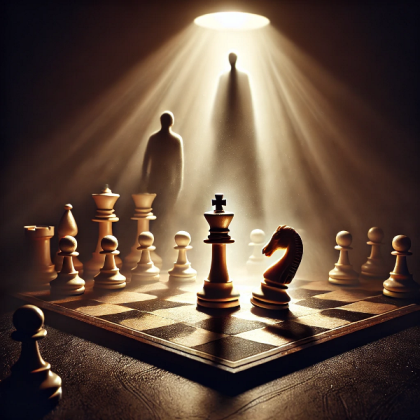


The Whisper of the Chess Board
When silence speaks louder than a thousand strategies.
It begins quietly.
Two players.
Thirty-two pieces.
One board.
No noise. No chaos. Just stillness—pregnant with possibility.
One move. One moment. One hesitation.
And suddenly, the entire game begins to unfold.
A story is written without words—only intention.
In this still, black-and-white battlefield, the first truth emerges:
You cannot win without letting go.
But we try. We grip. We guard. We grasp for control. Isn’t that how we live too?
What if the first move toward peace… is surrender or sacrifice?
The Fear of Letting Go
The tighter the grip, the faster things slip away.
We cling to pieces like they are lifelines. A pawn we won’t part with. A queen we overprotect. A plan we just can’t change.
Why?
Because letting go feels like failure.
Because sacrifice sounds like loss.
But real failure is when we refuse to move.
And real loss is when we trade the whole game for a single piece.
What pieces are you clinging to right now?
Your pride? Your pain? Your past?
And at what cost?
Life Imitates the Game
Your everyday is a quiet chessboard.
Life is nothing but a long, slow game of choices.
We defend egos instead of listening. We protect jobs that numb us. We stay in roles that shrink our souls. And the strangest part? We call this loyalty, consistency, success.
But deep within, we know the truth:
It’s fear.
And fear never wins the long game.
Where in your life are you playing not to lose?
Because playing not to lose… is the fastest way to lose yourself.
Sacrifice as Strategy
Letting go isn’t weakness. It’s divine intelligence.
In chess, what seems like loss is often liberation.
A knight sacrificed to unlock the king’s safety.
A bishop traded to open a future five moves away.
It’s not emotion—it’s vision.
The wisest players don’t cling. They release with reason.
Just like the soul.
It doesn’t evolve by clinging to old beliefs, broken patterns, or tired titles.
It evolves by shedding them.
What are you willing to lose today… so your highest self can win tomorrow?
The Gita’s Grand Strategy
The battlefield is not outside you. It’s within.
Arjuna was a warrior paralyzed by emotion. Not because he feared death, but because he was attached. To people. To identity. To outcome.
And Krishna, timeless and calm, said:
“You have the right to act, but not to the results.” (Gita 2.47)
“Evenness in success and failure—that is Yoga.” (Gita 2.48)
In other words:
Play the game—but don’t become the game.
Don’t play for applause. Don’t play for approval.
Play because it is your Dharma—your truth in motion.
Losing to Win
Sometimes it’s the loss that unlocks the soul.
We think loss is the enemy.
But what if it’s the teacher?
You lose the job—find your purpose.
Lose a relationship—find your self-worth.
Lose your plan—find divine timing.
What if “losing” is just life clearing the board for your checkmate?
In chess, the piece you’re afraid to let go might be blocking your victory.
In life, it might be blocking your becoming.
Why Chess is Different
Not every game touches the soul.
In chess, you win by understanding the sacrifice.
By seeing what others miss. By trusting the quiet.
It’s a game of karma and consciousness.
That’s why it’s the only game that feels like prayer.
The Question that Matters
Are you playing for the piece, or for the purpose?
Next time you’re about to hold on too tightly—ask yourself: What am I afraid to lose? And what might I gain if I let it go? Sometimes, protecting the wrong thing is what’s stopping the right thing from entering. Because often:
To save a piece in chess, people have lost games.
But those who move with clarity, faith, and detachment?
They don’t just win games.
They win themselves.


Nice
Well said!
Not only was the concept flowing smoothly and powerfully but also the language. The choice of words, sentences, emotions associated with actions… Everything tied up so crisply and effectively!
Thank you for finding it in you to write this piece down!