

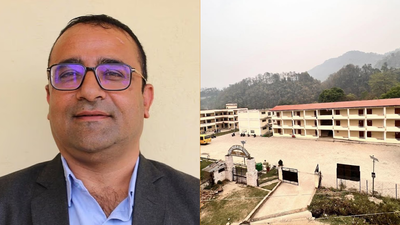


It was a normal school morning in Nuwakot, Nepal. Inside Tribhuvan Trishuli Secondary School, lessons were underway and around 900 children were on the school premises. Nobody knew that, within minutes, the entire building would disappear beneath a wall of water.
Rajendra Dawadi, the school’s 47-year-old principal and an English teacher, received a phone call at around 9:20 that morning. A friend from upstream warned him that the river had already swept through a nearby settlement. Soon, another warning came—a parent arrived at the school saying the water was rising rapidly.
Dawadi had a choice. Wait for confirmation, or act on the warning. He chose the children. He rang the school bell and ordered teachers to get everyone out immediately.
Students were rushed from their classrooms towards higher ground. Dawadi also called the school-bus drivers and told them to turn back. One bus he could not reach had already begun crossing the bridge. Teachers led the children uphill, eventually gathering them at a safer spot beneath a Bodhi tree.
Then the flood arrived. The three-storey school building was swept away by the raging Trishuli River. The destruction came so quickly that there was almost no time between the children’s escape and the school’s collapse.
The children were alive. The school was gone. Later reports put the total number of students under Dawadi’s school at 1,643, making the scale of his decision even more extraordinary.
But Dawadi does not describe himself as a hero. He says he was simply doing his duty.And perhaps that is what makes his story so powerful.
A principal’s responsibility is usually measured in classrooms, lessons and examinations. On that August morning, Dawadi’s responsibility became much bigger: to get every child away from danger before it was too late.
He did not know with certainty that the flood would reach the school. He simply understood that losing one day of classes was nothing compared with risking hundreds of lives.
The school may have been washed away. But the lives inside it were not.Today, Dawadi’s story stands as a reminder that courage is not always about doing something extraordinary. Sometimes, it is simply having the courage to make the right decision before everyone else is ready to believe the danger is real.

