

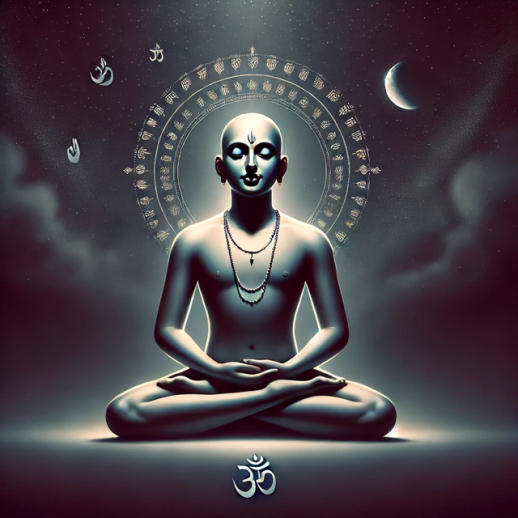


A Personal Reflection on the Master of Silence and Self-Realization

Introduction: Many Paths, One Light
The path to enlightenment has never worn just one robe or spoken in a single tongue. It has walked barefoot across deserts, sat still beneath trees, whispered through poetry, and wept on the cross. Buddha attained stillness under the Bodhi tree, offering the middle path of mindfulness and balance. Jesus, in an act of supreme surrender, radiated forgiveness even in crucifixion — showing that love transcends death. The Sufi mystics, like Rumi and Al-Hallaj, danced into divine madness, dissolving the self in the ocean of the Beloved. And in Islamic mysticism, the path of fanaa — the annihilation of ego — speaks of the same eternal vanishing into truth.
Each path reveals a different face of the same light. Some dissolve in ecstasy, others in silence. Some embrace the world with compassion; others transcend it in deep solitude.
And among them all stands Vardhaman, The Mahaveer — stark, silent, salient of all — walking not with metaphor or miracles, but with the raw courage to face existence exactly as it is. His was not a path of celebration or emotional sacrifice, but a path himself – a journey of radical acceptance. Where others spoke, Mahaveer remained silent. Where others surrendered, he simply stood still. He didn’t escape the world — he allowed it to pass through him like wind through a hollow flute, until only the witness remained.
1. The Inner Scientist
I don’t see Mahaveer as a moral teacher or a philosopher. I see him as a metaphysical scientist — someone who experimented, not with the outer world, but with the depths of human awareness. His twelve years of silence and austerity weren’t acts of denial, but tools of inner observation. There was nothing abstract about his path — it was precise, almost mathematical.
2. Enlightenment in Darkness
It moves me deeply that Mahaveer attained enlightenment on Amavasya — the darkest night of the moon. To me, this isn’t a coincidence. It symbolizes the courage to descend into the void, into the unknown, and to emerge with inner light. While many others like Buddha attained the wisdom on the full moon, Mahaveer was the only one whose light came from within the darkest silence. He didn’t escape the dark — he embraced it and became a flame.
3. Ahimsa as Awareness
The word Ahimsa often gets reduced to a moral code — a rigid list of dos and don’ts. But in my understanding, non-violence isn’t a behavior to enforce — it is the natural fragrance of a silent, ego-free consciousness. When awareness arises, violence withers. Mahaveer didn’t “follow” Ahimsa — he became it. His compassion was not effort; it was essence.
4. Silence and Renunciation
Mahaveer’s silence wasn’t mere abstention from speech — it was a profound presence without noise. And his nudity was not poverty — it was total transparency, a stripping away of all roles, masks, and identities. It wasn’t rebellion for the sake of rebellion, but renunciation without ritual — just the pure gesture of being.
5. The Truth is Many-Sided
One of Mahaveer’s most beautiful contributions is Anekantavada — the idea that truth is many-faceted. I feel this is not just tolerance but spiritual humility: a recognition that no single viewpoint can contain the whole. It’s a philosophy of openness — something we need now more than ever. Truth is not a point; it’s a prism.
6. Mahaveer and Ego-Death
To me, Mahaveer’s path was ultimately psychological. Every act of silence, fasting, walking — it was all about dismantling the ego. It was a complete stripping away of everything false, until only the witness remained. In a way, he was a psychologist of the soul, not by theory but by method — by direct experience.
The Fire That Became Ash
And yet, I often feel sad when I look at how Mahaveer’s teachings have been institutionalized. His burning quest for freedom has often been reduced to ritual fasting, food rules, and intellectual rigidity. What was once inner fire has, in many cases, been turned into ash. The living revolution became a religion of fear and formality.
Conclusion: Jainism Is Not Sacrifice — It Is Sacred Acceptance
Mahaveer, to me, is not a figure of the past. He is a living archetype of silence, fearlessness, and pure presence. He doesn’t demand belief — he invites inquiry. He doesn’t ask for worship — only for witnessing.
And Jainism, as I understand it through him, is often mistaken. It is not a path of dry renunciation or grim sacrifice. It is not about saying “no” to life — it is about saying “yes” to the whole. Yes to stillness. Yes to pain. Yes to death. Yes to the mystery.
Jainism is not about giving up — it is about giving in to the truth of what is. It is a surrender so complete that it looks like silence, a love so total that it appears detached. Mahaveer’s journey was not an escape from the world, but a deep acceptance of its fleetingness, its silence, its unspeakable beauty.

